Choosing the right mortar is one of the most important decisions when repairing or repointing brickwork.
For many London homeowners, the question is:
Should you use lime mortar or cement mortar when repointing brickwork?
The answer depends on the age and construction of the building, the type and hardness of the bricks, the existing mortar, exposure to weather and the way the wall was originally designed to manage moisture.
For many older London properties—particularly Victorian, Georgian and Edwardian buildings—lime mortar is often more compatible with the original masonry than a hard modern cement-rich mortar.
However, that does not mean lime mortar is automatically correct for every building.
Modern properties constructed with harder bricks and different wall systems may be designed for cement-based mortars.
The objective is therefore not to choose the “strongest” mortar.
It is to choose a mortar that is compatible with the brickwork it is protecting.
Historic England advises that repair materials for older buildings should be selected according to how the building was originally constructed, because inappropriate modern materials can trap moisture and contribute to deterioration.
At DW Brickwork Restoration, we assess the existing masonry before recommending the appropriate approach for pointing or repointing London properties.
What Is Mortar?
Mortar is the material used between bricks or stones to create joints and help form a complete masonry wall.
Although mortar contributes to structural stability, it performs several other important functions.
A suitable mortar can:
- Accommodate small amounts of movement
- Help manage moisture
- Protect the edges of bricks
- Reduce weather penetration
- Create the finished appearance of masonry
- Allow individual bricks to be repaired or replaced
- Act as the more sacrificial element of traditional masonry
This last point is particularly important when dealing with historic brickwork.
Ideally, the mortar should weather before the bricks do.
Replacing mortar is much easier and less destructive than replacing hundreds of damaged period bricks.
What Is Lime Mortar?
Lime mortar uses lime as the principal binder rather than relying primarily on Portland cement.
Lime has been used in British construction for centuries and was common in traditional buildings before widespread adoption of modern cement.
The exact properties vary according to the type of lime and the mortar specification.
Common categories include:
- Non-hydraulic lime
- Natural hydraulic lime
- Hot-mixed lime mortars
- Traditionally prepared lime putty mortars
There is no single “lime mortar mix” suitable for every building.
The appropriate mortar depends on factors such as:
- Brick hardness
- Joint width
- Building age
- Existing mortar
- Exposure
- Wall construction
- Historic significance
The Society for the Protection of Ancient Buildings notes that lime mortar was widely used on older buildings and generally provides a more permeable joint than the masonry itself, allowing weathering to occur preferentially in the mortar rather than the brick or stone.
What Is Cement Mortar?
Modern cement mortar typically uses Portland cement as a strong hydraulic binder combined with sand and water.
Depending on the application, lime or other additives may also be included.
Cement mortar became increasingly common with modern construction because it can provide:
- Faster strength development
- High compressive strength
- Predictable performance
- Faster construction
- Good suitability for many modern masonry systems
There is nothing inherently “bad” about cement mortar.
It is used successfully in millions of modern buildings.
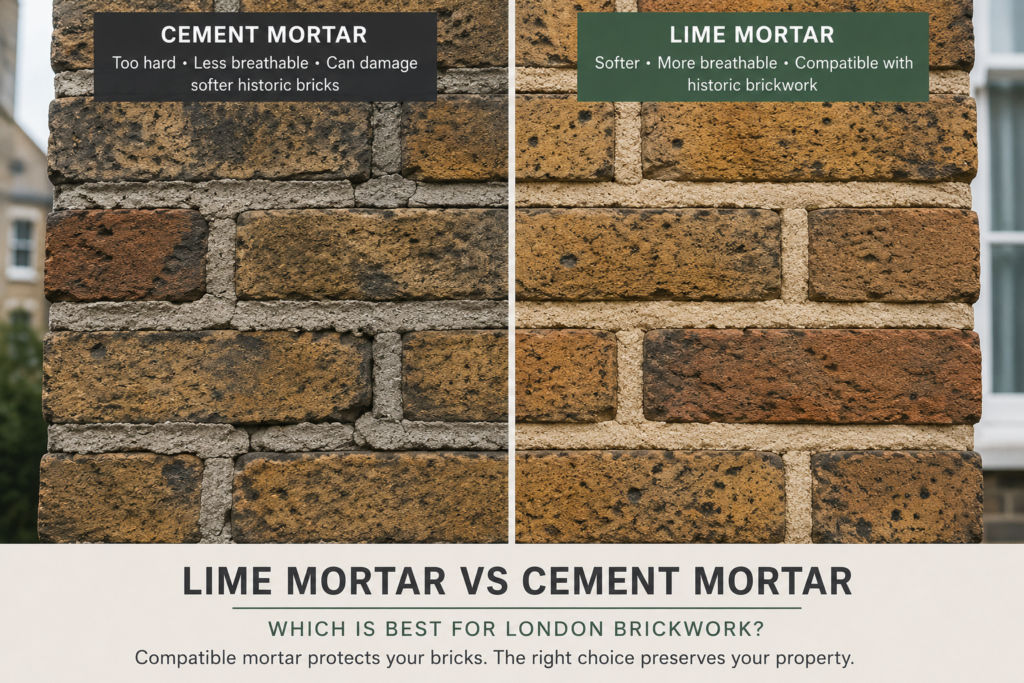
Problems arise when a very hard, dense cement-rich mortar is applied to softer historic masonry that was originally designed to work with more flexible and permeable lime mortar.
Lime Mortar vs Cement Mortar: Key Differences
| Feature | Lime Mortar | Cement-Rich Mortar |
| Flexibility | Generally more flexible | Generally more rigid |
| Permeability | Usually more vapour-permeable | Usually less permeable |
| Strength | Normally softer | Normally stronger |
| Setting | Typically slower | Typically faster |
| Traditional buildings | Often highly suitable | May be inappropriate if too hard |
| Modern construction | Can be used in some cases | Commonly used |
| Moisture movement | Helps traditional walls dry through joints | May restrict drying if overly dense |
| Movement | Better able to accommodate small movement | More prone to cracking when movement occurs |
| Repair philosophy | Mortar acts sacrificially | Brick may become weaker element if mortar is too hard |
| Appearance | Often softer and more traditional | Can appear harder/sharper depending on finish |
The table is a general comparison only.
Actual performance depends on the mortar formulation rather than simply whether the label says “lime” or “cement”.
Why Is Lime Mortar Often Used on Victorian Houses?
Victorian London contains enormous amounts of traditional solid-wall brickwork.
Many properties were constructed using bricks and mortars that are softer and more porous than those used in many modern buildings.
These walls typically manage moisture differently from modern cavity-wall construction.
Historic buildings were generally designed to absorb small amounts of moisture and then allow it to evaporate.
Lime mortar supports this process because it is usually more permeable than dense cement-rich alternatives.
Historic England explains that traditional lime mortars and related materials have interconnected pore structures that allow moisture to disperse through masonry.
For that reason, appropriate lime mortar may be particularly suitable for:
- Victorian terraces
- Georgian townhouses
- Edwardian houses
- Historic cottages
- Listed buildings
- Conservation-area properties
- Traditional solid-wall construction
- Period boundary walls
- Historic brick façades
Why Can Hard Cement Mortar Damage Old Brickwork?
One of the biggest misconceptions in masonry repair is that stronger mortar must be better mortar.
That is not always true.
Mortar should generally be softer and more accommodating than the masonry around it.
If extremely hard mortar surrounds relatively soft bricks, environmental stresses can become concentrated in the brick instead of the joint.
Potential problems include:
- Brick-face erosion
- Spalling
- Cracked bricks
- Trapped moisture
- Frost damage
- Salt damage
- Cracking along mortar joints
- Damaged brick edges during future removal
SPAB specifically warns that hard cementitious pointing on older buildings can accelerate deterioration because the bricks or stone become the more permeable element and experience greater frost and salt action.
What Does “Breathable Mortar” Mean?
The word breathable is widely used in restoration, although masonry obviously does not breathe like a person.
In building terms, it generally refers to the ability of materials to allow moisture vapour and, in some circumstances, liquid moisture to move through and evaporate.
Traditional masonry walls need to dry.
If moisture becomes trapped behind dense coatings or excessively impermeable repair materials, problems may develop.
A suitable lime mortar provides a route for moisture movement through the joints.
This helps ensure that the mortar remains the more sacrificial element of the wall.
Does Lime Mortar Stop Damp?
Lime mortar should not be marketed as a miracle damp cure.
Damp can result from many issues, including:
- Leaking gutters
- Defective roofs
- Cracked render
- Failed flashing
- High external ground levels
- Plumbing leaks
- Poor drainage
- Condensation
- Damaged brickwork
However, using a more compatible permeable mortar can help traditional walls manage moisture more effectively.
If a property has damp problems, the cause should be investigated rather than simply repointing the entire façade.
Is Cement Mortar Ever Suitable for Brickwork?
Yes.
Cement-based mortars are appropriate for many modern buildings.
Properties built using modern engineering bricks, cavity-wall construction or high-strength masonry units may have been designed around stronger cementitious mortars.
This is why building age alone should not determine the specification.
The contractor should examine:
- Existing mortar
- Brick hardness
- Wall construction
- Age of the property
- Exposure
- Previous repairs
- Condition of the masonry
The correct question is not:
“Is lime better than cement?”
It is:
“Which mortar is compatible with this particular wall?”
How Can You Tell If Your House Has Lime Mortar?
Visual inspection can provide clues, although accurate identification may sometimes require closer examination or laboratory analysis.
Traditional lime mortar is often:
- Softer
- More porous
- Less uniform
- Lighter in colour
- More textured
- Easier to scratch than hard cement mortar
Older lime mortar may also contain visible aggregate, small lime inclusions or natural colour variations.
Hard cement-rich mortar often appears:
- Dense
- Smooth
- Grey
- Very hard
- Sharply finished
- Less weathered than surrounding bricks
However, appearance alone is not always conclusive.
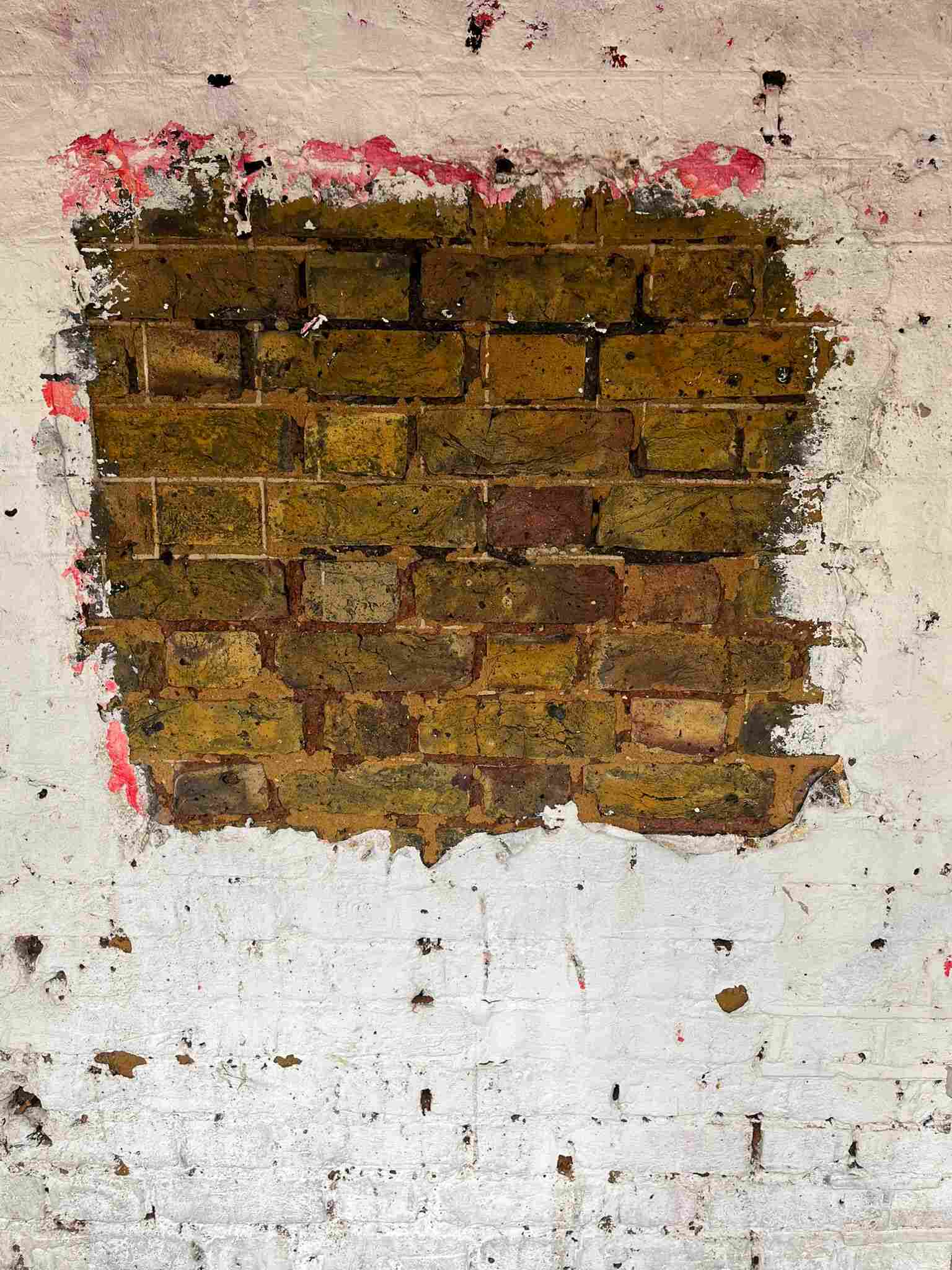
Many older properties have been repaired several times and may contain both lime and cement mortar.
What Happens When Victorian Brickwork Is Repointed With Cement?
Problems may not appear immediately.
A newly cement-pointed wall can initially look sharp and tidy.
Over time, however, a mortar that is too hard or impermeable may contribute to:
- Moisture being redirected through bricks
- Brick faces breaking down
- Frost-related deterioration
- Cracking caused by movement
- Loss of original character
- Difficult future repairs
SPAB notes that traditional lime mortar can accommodate small movements more readily, while dense cement-rich pointing can develop cracks and contribute to accelerated decay of old masonry.
Should Old Cement Mortar Be Removed?
Not automatically.
This is an important distinction.
If inappropriate cement pointing has been applied to historic brickwork, removing it may seem like the obvious solution.
However, extremely hard cement mortar can be difficult to remove.
Attempting to rake it out aggressively can damage the edges of soft historic bricks.
SPAB recommends trialling removal first and, where hard cement cannot be removed without damaging the surrounding masonry, sometimes leaving it until it naturally becomes loose may be preferable.
Professional assessment is therefore essential.
When Does Brickwork Actually Need Repointing?
Not every old wall needs complete repointing.
Sound historic mortar should generally be preserved wherever practical.
Historic England states that wholesale repointing is rarely necessary and that sound historic mortar can form an important part of the character and significance of a building.
Signs repointing may be required include:
- Mortar crumbling from joints
- Deeply eroded joints
- Loose mortar
- Open gaps
- Water penetration through joints
- Localised frost damage
- Previous failed repairs
Repointing purely because mortar looks old can remove original material unnecessarily.
Internal link: Link to Blog #6 when published:
How to Tell If Your Brickwork Needs Repointing: 10 Warning Signs
Lime Mortar Repointing Process
Professional lime mortar repointing typically includes several stages.
1. Inspect Existing Brickwork
The contractor examines the bricks, joints and previous repairs.
2. Identify the Existing Mortar
Where possible, the new mortar should be compatible with the original material.
Colour, texture, strength and aggregate all matter.
3. Carefully Rake Out Failed Mortar
Only deteriorated mortar should be removed.
Historic England and SPAB both emphasise careful removal because overly aggressive raking can damage brick edges.
4. Clean the Joints
Dust and loose material are removed to create a sound surface for the new mortar.
5. Prepare the Joints
The masonry may need controlled dampening so dry bricks do not pull moisture out of the fresh mortar too quickly.
6. Apply Compatible Lime Mortar
Mortar is carefully packed into the joints in suitable layers.
7. Finish the Joint
The finish should suit the age and style of the building.
Flush or nearly flush pointing is often appropriate on traditional masonry unless there is evidence for another historic finish.
8. Protect During Curing
Fresh lime mortar generally needs protection from:
- Frost
- Strong sun
- Rapid drying
- Wind
- Heavy rain
Lime cures differently from modern cement mortar and should not be rushed.
How Long Does Lime Mortar Take to Cure?
Lime mortar usually develops strength more slowly than cement-rich mortar.
Exact curing time depends on:
- Type of lime
- Mortar thickness
- Temperature
- Humidity
- Wind
- Building exposure
- Joint depth
This slower process is not necessarily a disadvantage.
It is part of the reason lime mortar remains relatively accommodating and suitable for many older buildings.
Repointing should generally be avoided during extreme weather.
SPAB advises protecting new lime work from frost, rapid drying, wind, strong sun and heavy rain.
What Is the Best Lime Mortar Mix for Repointing?
This is one area where online DIY advice can become misleading.
There is no universal lime mortar mix that is correct for every property.
The appropriate specification depends on:
- Existing historic mortar
- Brick strength
- Exposure
- Joint width
- Building location
- Moisture conditions
- Required finish
The objective should normally be to match the existing appropriate mortar in:
- Colour
- Texture
- Aggregate
- Strength
- Permeability
- Appearance
SPAB recommends matching existing appropriate historic pointing wherever possible and producing mortar samples or trial panels when a new specification is required.
For this reason, DW Brickwork Restoration should avoid publishing a single “1:3 lime mortar recipe” and presenting it as suitable for every London building.
Lime Mortar Repointing Cost
Lime mortar repointing can cost more than straightforward modern cement pointing because it can involve:
- Specialist materials
- Mortar matching
- Greater preparation
- Careful raking out
- Slower application
- Protection during curing
- Skilled heritage workmanship
Ubersuggest currently shows meaningful UK interest around both “lime mortar repointing” and “lime mortar repointing cost.”
For detailed pricing information, readers should be directed to Blog #1:
Repointing Cost London 2026: How Much Does Brick Repointing Cost?
Lime Mortar and London Stock Bricks
Traditional London stock bricks are a defining feature of the capital’s architecture.
Their distinctive yellow, buff and brown colouring can be seen throughout areas such as:
- Islington
- Camden
- Hampstead
- Highgate
- Kensington
- Chelsea
- Fulham
- Clapham
- Hackney
- Greenwich
- Westminster
Many of these buildings were originally constructed using relatively soft traditional mortar.
When restoration is needed, maintaining compatibility between brick and mortar helps protect the façade and preserve its appearance.
Victorian and Georgian Brick Repointing in London
Period brick restoration needs to consider more than structural strength.
Details such as mortar colour, aggregate and joint finish can significantly alter the appearance of a façade.
Poor repointing can make an attractive Georgian or Victorian building look artificially modern.
Professional heritage-style repointing should consider:
- Original mortar composition
- Historic joint profile
- Brick colour
- Brick hardness
- Previous alterations
- Local architectural character
Historic England notes that mortar joints make an important contribution to both the appearance and durability of historic brick and stone masonry.
Lime Mortar vs Cement Mortar: Which Should You Choose?
For many older London properties:
Lime mortar may be preferable where:
- The building was originally constructed in lime
- Bricks are relatively soft
- The wall is traditional solid masonry
- Moisture permeability is important
- The property is Victorian or Georgian
- Historic fabric needs preserving
Cement-rich mortar may be appropriate where:
- The building is modern
- Masonry units are designed for stronger mortar
- Existing compatible mortar is cementitious
- Structural design requires it
- The wall forms part of a modern construction system
The specification should be based on the actual building rather than a general rule.
Can Lime and Cement Be Mixed?
Some mortar formulations contain both lime and cement.
These are commonly used in modern masonry construction.
However, adding cement to a traditional lime mortar changes characteristics such as:
- Strength
- Flexibility
- Permeability
- Setting behaviour
For historic brickwork, simply adding a small amount of lime to a strong cement mortar does not automatically make it equivalent to traditional lime mortar.
SPAB notes that cement additions to lime mortars are generally discouraged for traditional repair now that a wider range of appropriate lime binders is available.
Do Listed Buildings Need Lime Mortar?
Many listed buildings use lime mortar, but the correct repair approach should follow the historic construction.
Some listed buildings contain:
- Lime mortar
- Natural cement
- Early artificial cement
- Clay or earth mortars
- Special decorative pointing
Repointing can also affect the appearance and historic character of a listed façade.
Historic England notes that both material and pointing style matter when considering repairs to listed buildings.
Owners should check whether listed-building consent or conservation advice is required before carrying out significant alterations.
Lime Mortar Repointing Across London
DW Brickwork Restoration provides professional pointing and repointing services across:
- Central London
- North London
- South London
- East London
- West London
The existing DW Central London repointing page specifically discusses Victorian and Georgian façades, while the North London page highlights lime-mortar repointing for traditional properties in areas such as Hampstead, Islington and Highgate.
Why Choose DW Brickwork Restoration?
Correct repointing starts with understanding the existing brickwork.
DW Brickwork Restoration works with traditional and modern properties throughout London, providing services including:
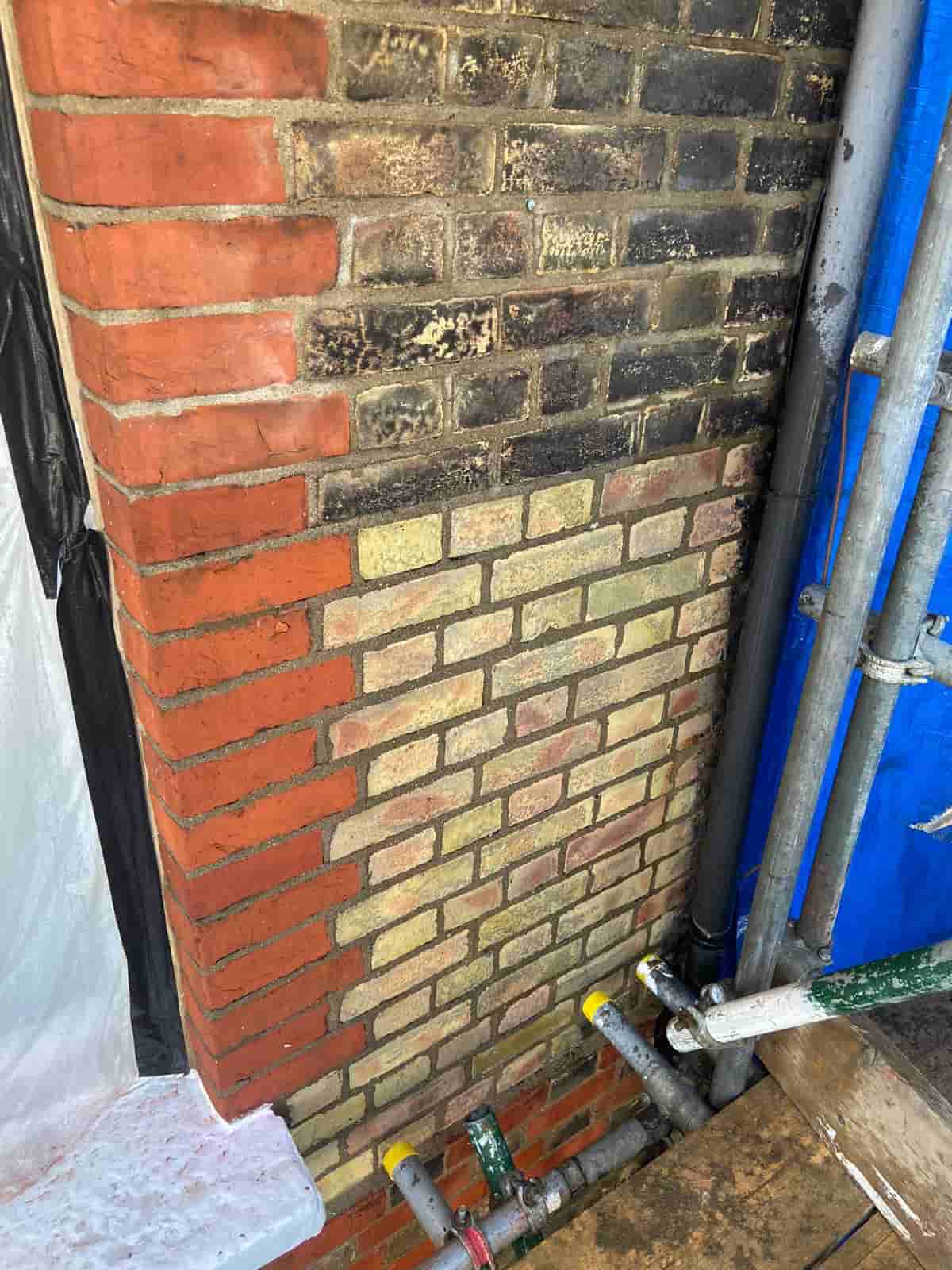
- Lime mortar repointing
- Brick pointing
- Traditional brick repointing
- Brick repairs
- Brick restoration
- Brick cleaning
- Paint removal
- Render removal
- Pebble dash removal
Our approach focuses on selecting materials and techniques that are appropriate for the building rather than applying the same mortar specification to every property.
Get a Lime Mortar Repointing Quote in London
If the mortar on your Victorian, Georgian or period property is crumbling, deeply recessed or has previously been repaired using an unsuitable material, professional assessment can determine the appropriate solution.
DW Brickwork Restoration provides specialist repointing services across London.
Preserve and Protect Your Original Brickwork
Speak with DW Brickwork Restoration about lime mortar repointing and traditional masonry restoration.
Call: 07400 421 172
Email: info@dwbrickworkrestoration.co.uk
Request a free, no-obligation assessment.