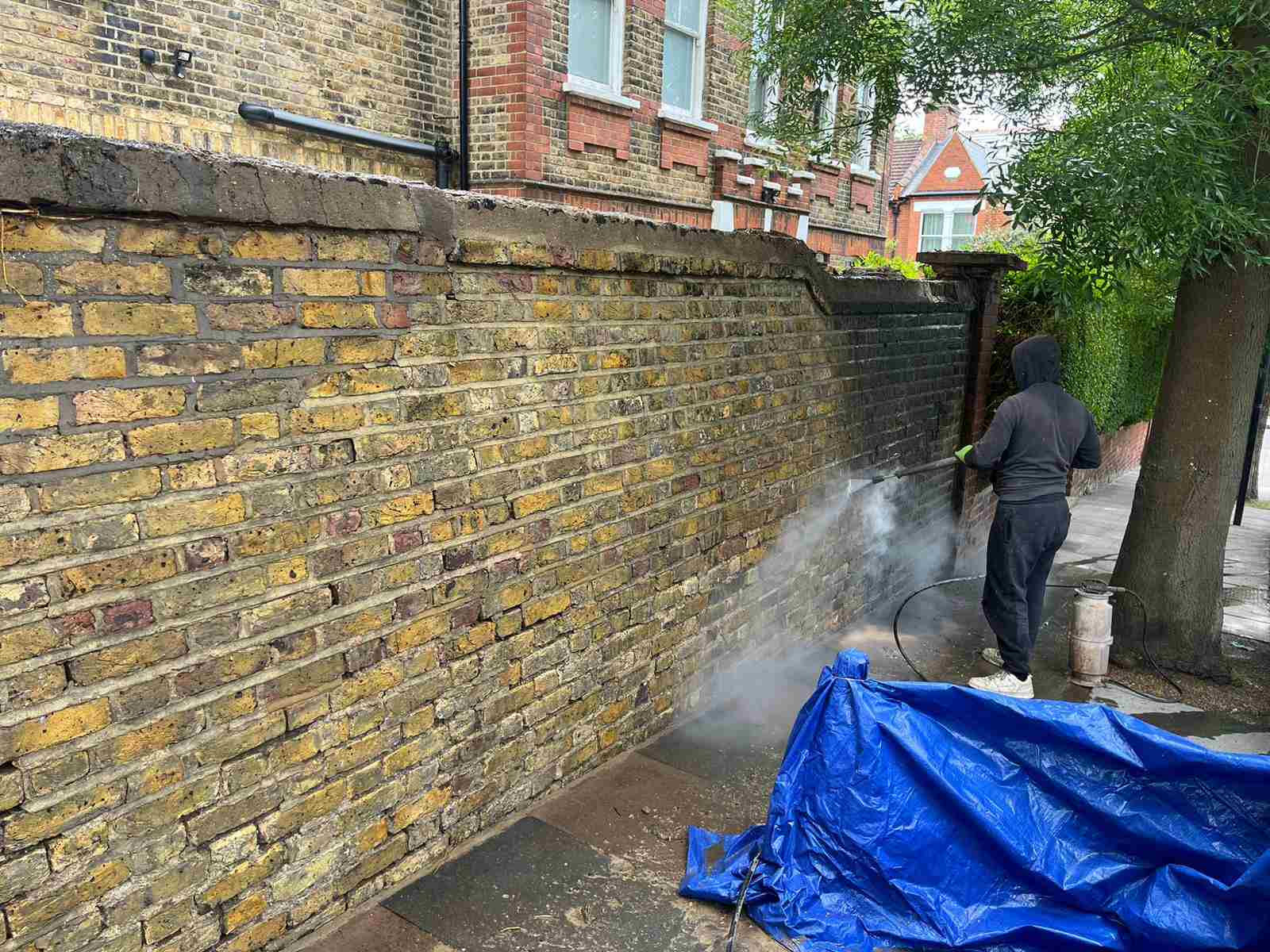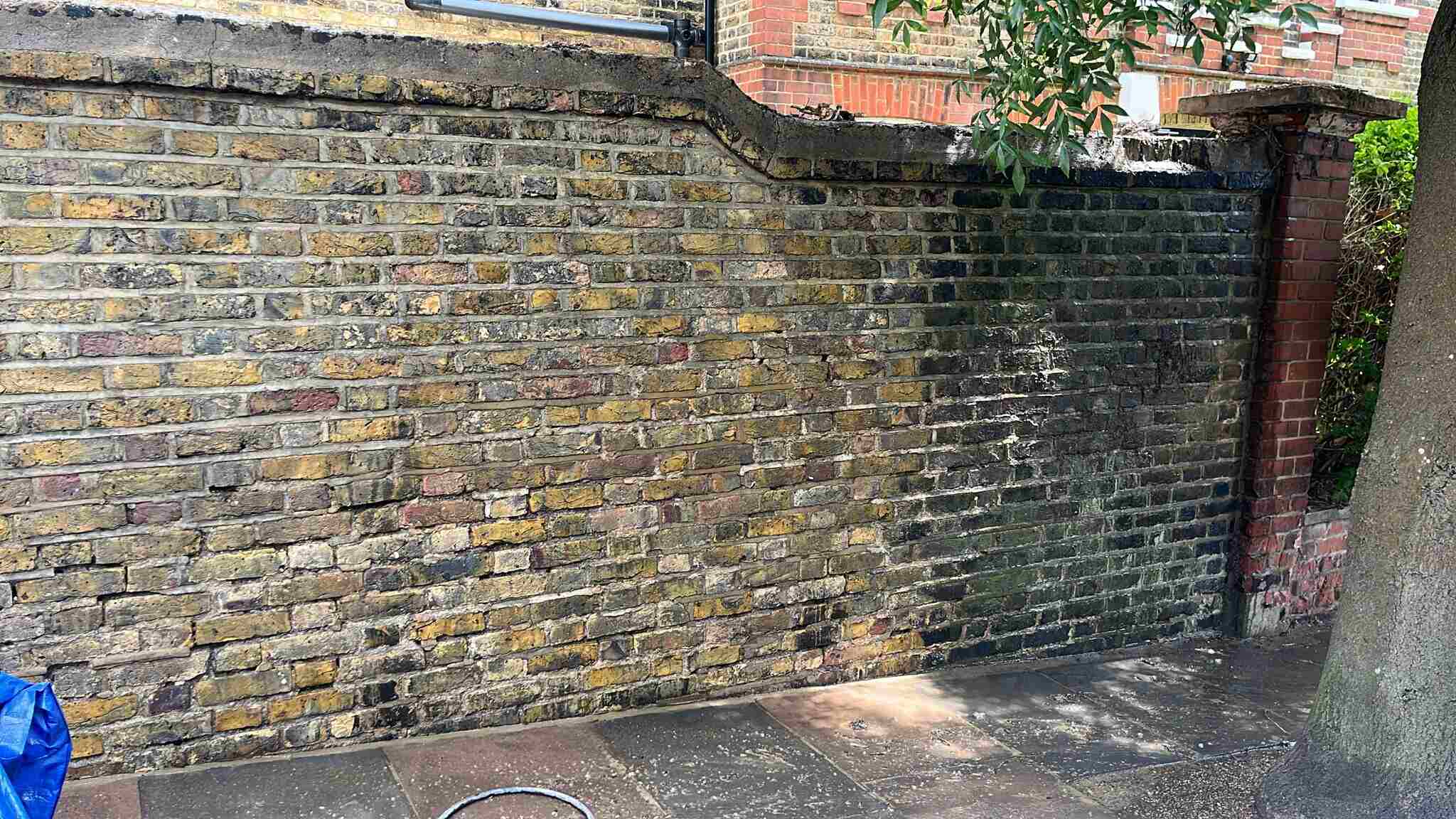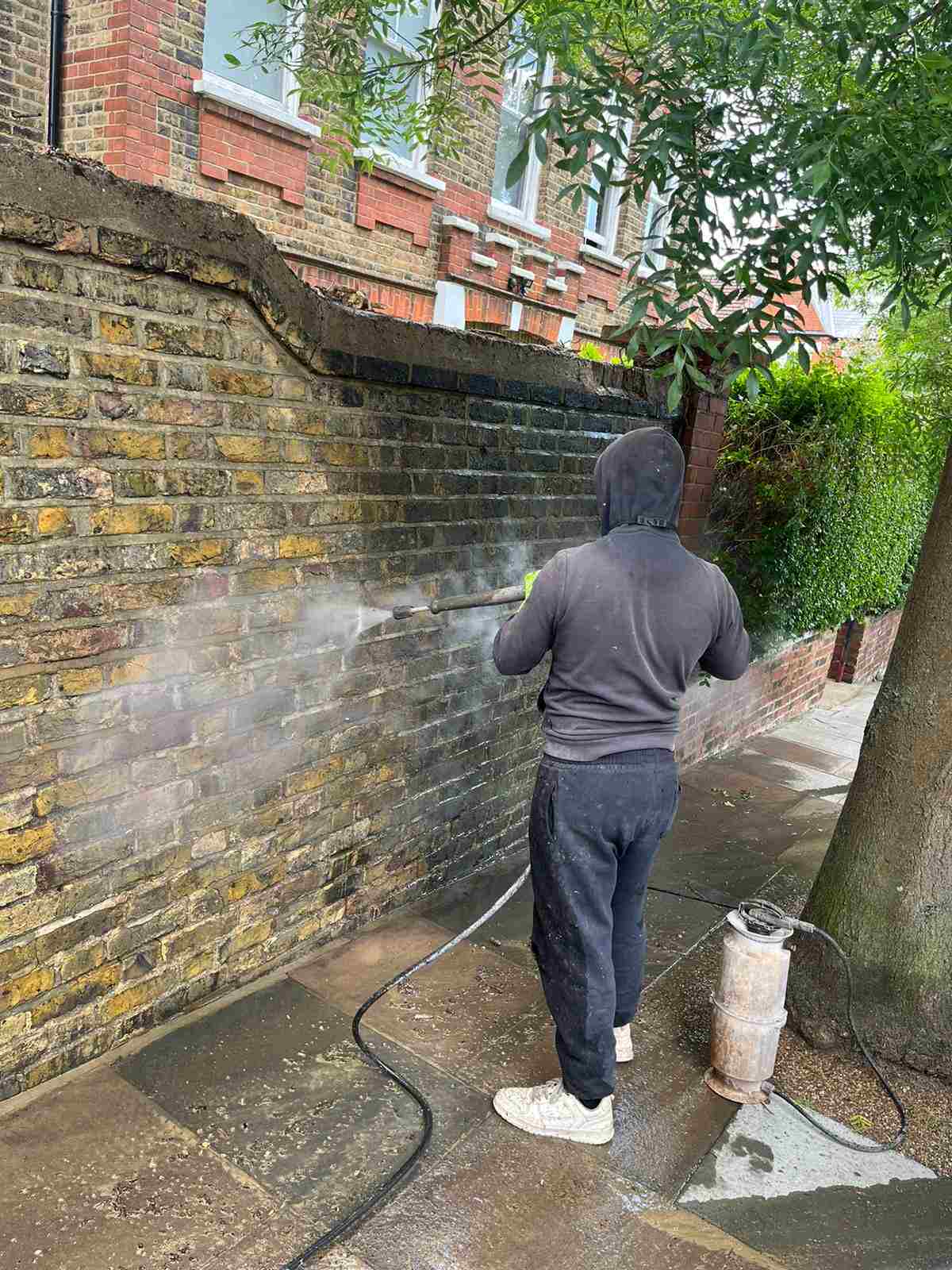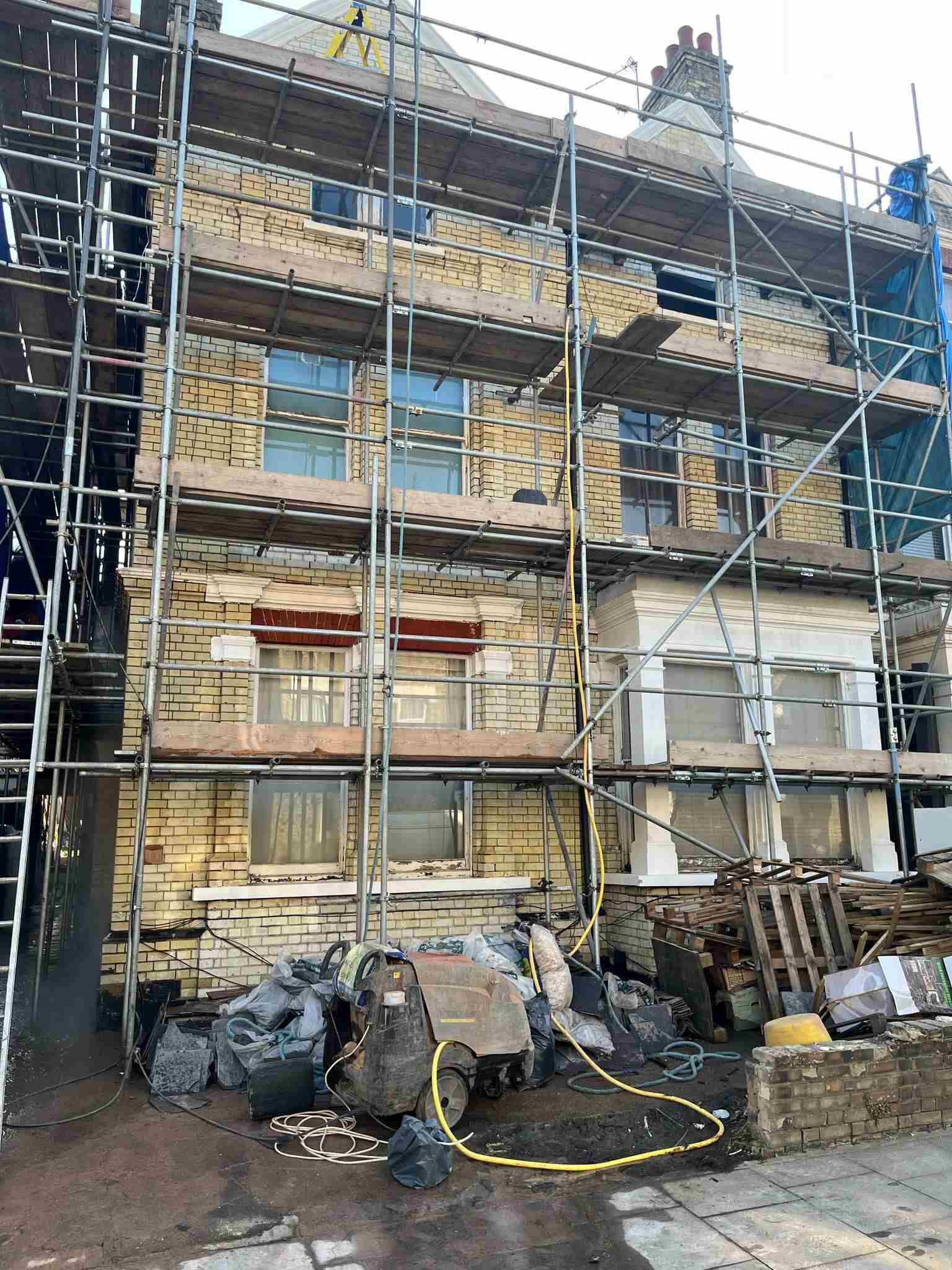
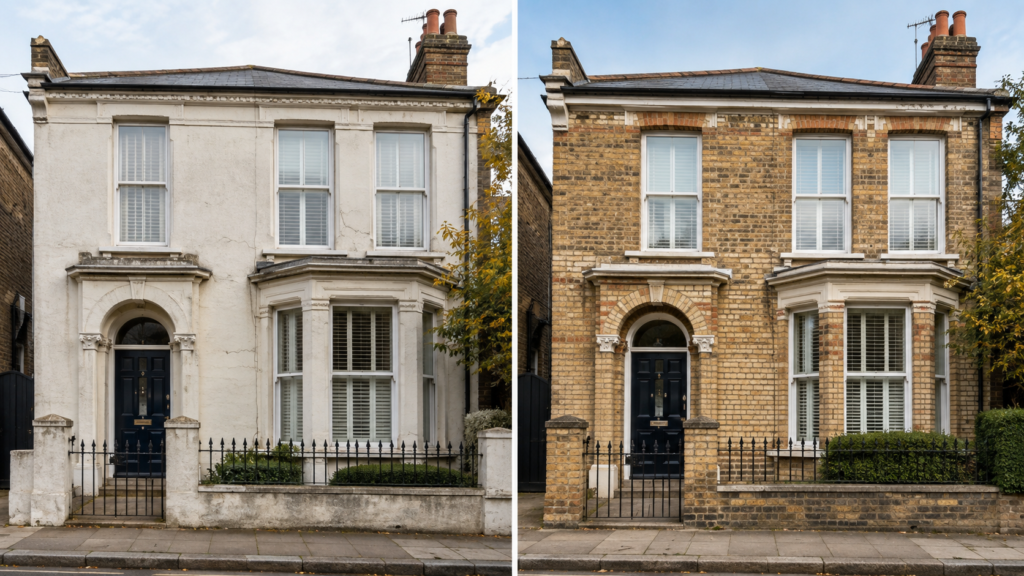
Removing old render can completely change the appearance of a property—particularly when attractive original brickwork has been hidden underneath for decades.
For homeowners considering restoring a Victorian, Edwardian or other period property, one of the first questions is:
How much does render removal cost in 2026?
As a broad UK guide, professional render removal currently costs approximately £25–£45 per m² for labour, with an average around £35 per m². A single elevation of a typical semi-detached property may cost approximately £900–£1,600, while complete removal from an entire property can cost several thousand pounds depending on access, scaffolding, render type and the condition of the masonry underneath.
These figures are general UK market benchmarks—not fixed DW Brickwork Restoration prices.
The actual cost of exposing original brickwork in London depends heavily on what happens after the render comes off.
The brickwork may need:
- Cement residue removal
- Specialist brick cleaning
- Brick replacement
- Crack repairs
- Lime mortar repointing
- Previous repairs correcting
- Scaffolding
- Waste removal
This is why a professional inspection and test area are so valuable before committing to a full façade.
At DW Brickwork Restoration, render removal forms part of a wider brick-restoration process designed to uncover and restore original masonry while minimising unnecessary damage.
Internal link: Link “professional render removal in London” to:
How Much Does Render Removal Cost in 2026?
Current UK pricing guidance gives us a useful starting point.
| Render Removal Work | Typical 2026 Guide |
| Render removal per m² – labour only | £25–£45 |
| Average labour cost per m² | Around £35 |
| Single elevation, semi-detached | £900–£1,600 |
| Full semi-detached property | £2,000–£4,000 |
| Full detached property | £3,000–£6,000 |
| Scaffolding | Additional where required |
| Waste disposal | Additional |
| Brick cleaning/restoration | Additional |
| Repointing | Additional where required |
MyJobQuote’s July 2026 UK cost guide places professional render removal at approximately £25–£45 per m² for labour, with an average of £35 per m². It estimates a typical full semi-detached property at approximately £2,000–£4,000 and a detached property at around £3,000–£6,000 before some additional costs.
London properties can vary considerably because of:
- Building height
- Scaffolding requirements
- Restricted access
- Parking
- Neighbouring properties
- Render thickness
- Period masonry
- Brick repairs
- Waste removal
So these numbers should be treated as budgeting guides rather than quotations.
Example Render Removal Cost Calculation
Imagine a façade contains approximately 40m² of rendered wall.
Using an illustrative labour rate of £35 per m²:
40m² × £35 = £1,400
But £1,400 should not automatically be treated as the project’s total cost.
Additional work might include:
Scaffolding
- waste disposal
- brick cleaning
- cement residue removal
- brick repairs
- repointing
The final restoration cost could therefore be substantially higher than the basic render-removal calculation.
This is why homeowners should ask whether a quotation covers removing render only or fully restoring the exposed brickwork.
What Affects Render Removal Cost?
Several factors can change the price considerably.
1. Type of Render
Not every render behaves the same way.
Common external finishes include:
- Traditional lime render
- Cement render
- Sand and cement render
- Pebble dash
- Roughcast
- Modern polymer render
- Silicone render
- Monocouche systems
- Textured coatings
Some coatings release relatively easily.
Others can be extremely hard and firmly bonded to the brick underneath.
Hard cement render may require slower, more controlled removal because attempting to prise off large sections can damage softer historic masonry.
2. Thickness of the Render
A thin coating is generally easier to remove than several thick layers.
Older properties may have:
- Original render
- Later repairs
- Paint
- Cement patches
- Additional coatings
built up over many years.
What appears to be one simple exterior finish may actually consist of multiple layers.
3. How Strongly the Render Is Bonded
This is one of the biggest variables.
Sometimes old render has already:
- Cracked
- Blown
- Detached
- Become hollow
and can be removed comparatively easily.
Other render may be strongly adhered to the masonry.
Aggressive removal in those situations risks taking the surface of the brick away with the render.
A test area is therefore highly recommended.
4. Condition of the Brickwork Underneath
This can change the entire project.
Render removal may expose beautiful original brickwork requiring relatively modest restoration.
Or it may expose:
- Spalled bricks
- Cracks
- Missing bricks
- Cement repairs
- Previous alterations
- Damaged mortar
- Poor-quality masonry
The final cost then becomes a brick restoration project, not simply a render-removal job.
5. Scaffolding
Ground-floor walls are much easier to work on than two-, three- or four-storey façades.
Scaffolding may be necessary to provide safe access and allow workers to remove render carefully.
It can become especially important around:
- Upper floors
- Chimneys
- Gables
- Narrow London streets
- Extensions
- Conservatories
- Neighbouring properties
Access costs should be confirmed separately within the quotation.
6. Waste Disposal
Render is heavy.
Removing an entire external façade can generate a substantial amount of waste.
The project may require:
- Waste bags
- Skips
- Labour for removal
- Licensed disposal
Current UK cost guides specifically identify waste disposal and scaffolding as common additional expenses beyond basic render-removal labour.
7. Brick Cleaning After Render Removal
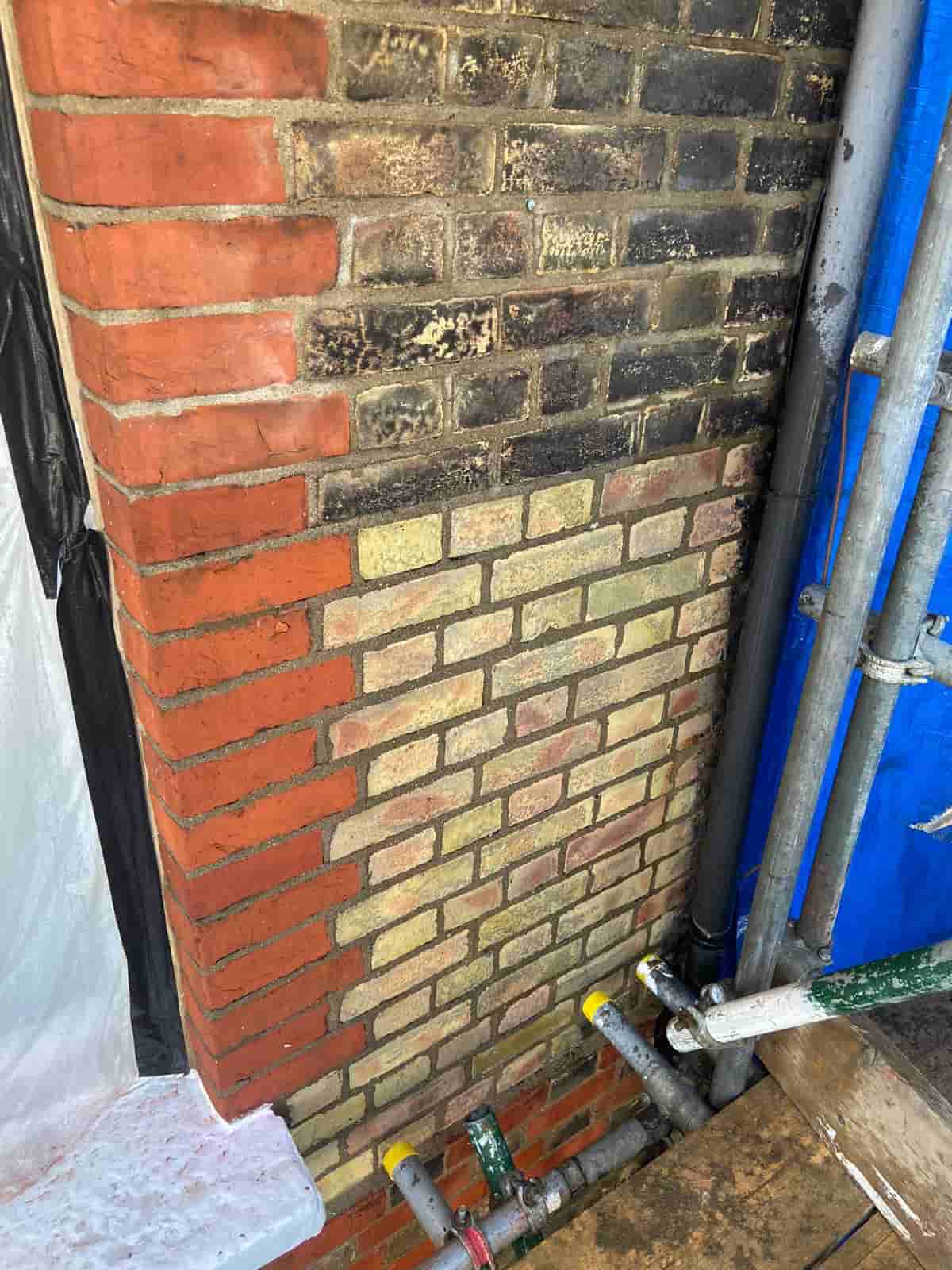
The masonry will rarely look finished immediately after the render comes off.
Bricks may still have:
- Cement residue
- Mortar
- Dust
- Pollution
- Paint
- Adhesive
- Surface staining
A controlled cleaning process may therefore be required.
Possible methods include:
- DOFF steam cleaning
- Specialist low-pressure cleaning
- Manual detailing
- Carefully controlled masonry cleaning
The method should depend on the condition of the brick.
8. Repointing After Render Removal
Mortar joints underneath render can be in very different condition from what is visible before removal.
You may discover:
- Deeply recessed mortar
- Loose mortar
- Missing joints
- Hard cement patches
- Cracked joints
- Mixed previous repairs
Where the original mortar remains sound, it should not automatically be replaced.
Where it has genuinely failed, repointing can form an important part of the restoration.
Why Remove Render From Brickwork?
Cost is only one part of the decision.
Homeowners usually remove render for one of four main reasons.
To Reveal Original Brickwork
This is especially popular on London’s period properties.
Later render may conceal:
- London stock brick
- Red Victorian brick
- Decorative arches
- Original window surrounds
- Historic brick bonds
- Traditional masonry details
When the underlying brickwork is suitable, carefully exposing and restoring it can significantly change the building’s character.
Because the Render Is Failing
Common signs include:
- Cracking
- Bulging
- Hollow areas
- Loose sections
- Flaking
- Detachment
- Heavy staining
Current UK guidance notes that render removal is often required when the existing coating has cracked, blown or begun to separate from the substrate.
Because the Render Is Inappropriate for the Building
This is particularly relevant to older solid-wall construction.
Traditional buildings often manage moisture through relatively permeable materials.
SPAB warns that hard modern cement render can be incompatible with some historic buildings because it can restrict evaporation and trap moisture behind cracks or dense coatings.
Historic England similarly explains that traditional permeable wall construction relies on moisture being able to move through and evaporate from materials such as lime mortar and lime render.
This does not mean every cement-rendered house needs its render removed.
The building should be assessed individually.
To Restore the Property’s Original Appearance
Render may have been added long after construction.
Removing it can potentially restore the visual appearance of:
- Victorian terraces
- Georgian houses
- Edwardian properties
- Period townhouses
- Traditional commercial façades
But exposed brick is not always the correct final finish.
Is There Always Good Brickwork Under Render?
No.
This is one of the most important expectations to manage.
Render may have been applied because the original wall:
- Contained unattractive bricks
- Had been heavily repaired
- Had structural alterations
- Was never designed to be exposed
- Was built from blockwork
- Required weather protection
SPAB notes that where render has previously been stripped away, replacing an appropriate render can sometimes actually be the better conservation solution.
Therefore:
Removing render does not automatically mean exposed brick should become the final finish.
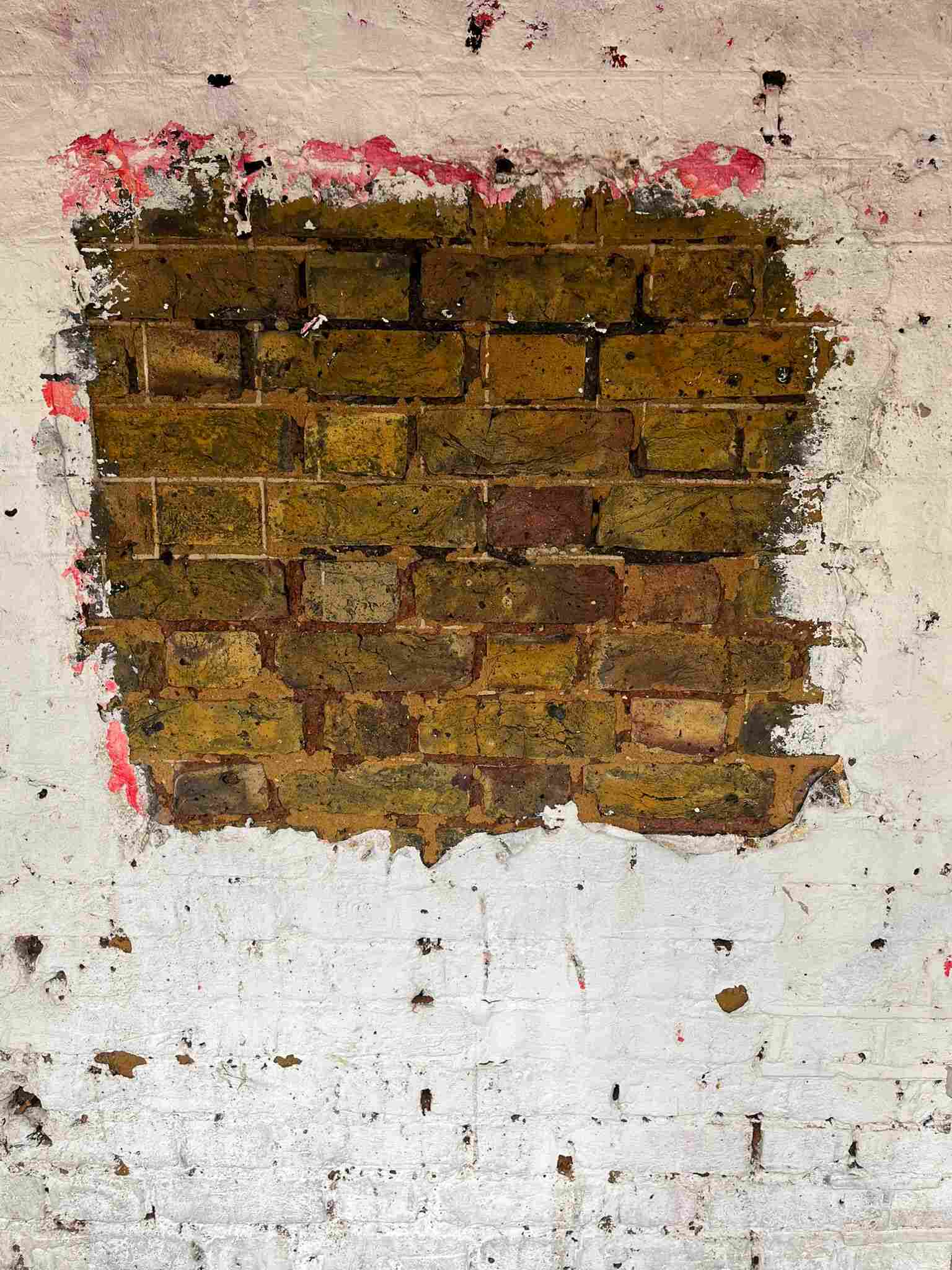
A test patch helps establish what lies underneath.
Why Should You Do a Test Patch First?
A small trial area can answer several important questions.
What kind of brick is underneath?
You may uncover:
- London stock brick
- Red clay brick
- Modern masonry
- Blockwork
Is the brick face intact?
Hard render may be strongly bonded.
What condition is the mortar in?
Repointing requirements can often only be understood once the wall is exposed.
How much residue remains?
Removal difficulty varies greatly.
Is exposed brick realistic?
This may be the most important question of all.
DW Brickwork Restoration’s Central London Render Removal page already follows a process beginning with site inspection and testing, followed by controlled removal, brick cleaning and optional repairs/repointing.
That process should be reinforced in this article.
How Is External Render Removed?
Professional removal should be gradual and controlled.
Step 1: Inspection
The contractor identifies:
- Render type
- Visible cracks
- Hollow areas
- Building age
- Brick type
- Access
- Moisture issues
Step 2: Test Area
A small section is removed.
This helps establish adhesion and masonry condition.
Step 3: Protect the Property
Protection may be required around:
- Windows
- Doors
- Roof details
- Paths
- Neighbouring property
- Gardens
- Drainage
Step 4: Remove the Render Carefully
The coating is removed in manageable areas rather than simply ripping large sheets from the wall.
This is particularly important on softer brick.
SPAB’s guidance on traditional buildings warns that levering large sections of hard cement render away can cause severe damage to soft materials underneath.
Step 5: Remove Residue
Once the main coating is gone, remaining:
- Cement
- Mortar
- Paint
- Adhesive
may need specialist treatment.
Step 6: Clean the Brickwork
Controlled cleaning reveals the condition and natural appearance of the masonry.
Step 7: Repair Damaged Bricks
Damaged masonry can then be:
- Repaired
- Replaced
- Matched sympathetically
Step 8: Repoint Where Necessary
Failed joints are carefully removed and replaced using compatible mortar.
Step 9: Final Inspection
Only after cleaning and repairs can the finished façade really be assessed.
Can Cement Render Damage Old Brickwork?
It can in some traditional buildings when the render is much harder and less permeable than the wall underneath.
SPAB explains that dense cement render can restrict evaporation from traditional walls. Cracks can then allow moisture behind the coating while making it more difficult for that moisture to evaporate.
Historic England also identifies inappropriate external cement render as a potential cause of moisture-related problems in historic construction.
However, cement render itself is not universally defective.
Modern buildings may have been specifically designed for cementitious external systems.
Compatibility is the key issue.
Does Removing Render Solve Damp?
Not automatically.
This needs to be communicated carefully.
Removing inappropriate or badly cracked render may help in some circumstances.
But damp can also be caused by:
- Leaking gutters
- Roof defects
- Failed flashing
- Plumbing
- Poor drainage
- High ground levels
- Condensation
- Cracks
A building should therefore be diagnosed before render is removed solely as a damp treatment.
Can Render Be Removed From Victorian Brick?
Often, yes.
But Victorian bricks can be softer than many modern masonry units.
Careless removal can cause:
- Chipped brick faces
- Broken edges
- Spalling
- Mortar damage
Victorian houses may also contain traditional lime mortar that needs preserving or replacing sympathetically.
A typical restoration might involve:
Render removal → residue cleaning → brick repairs → lime mortar repointing
rather than render removal alone.
Can Render Be Removed From London Stock Brick?
Yes in many cases, but London stock brick can require particularly sympathetic treatment.
London stocks are known for their:
- Yellow
- Buff
- Brown
- Orange
colour variations.
An aggressive cleaning process can remove original brick surfaces and create an unnatural appearance.
The aim should therefore be to reveal and preserve the character of the bricks rather than make century-old masonry appear brand new.
Render Removal vs Pebble Dash Removal
The two services overlap but are not identical.
Pebble dash normally consists of aggregate embedded into a render coat.
Standard render may be:
- Smooth
- Textured
- Painted
- Cement-based
- Lime-based
Pebble dash removal therefore often involves removing both the visible stone finish and its backing layer.
Render Removal vs Rendering Over Existing Render
Sometimes homeowners consider applying a new coating rather than stripping the old one.
Rendering over existing render may only be sensible when the original substrate is sufficiently stable and compatible with the proposed new system.
If existing render is:
- Loose
- Blown
- Cracked
- Damp
- Poorly bonded
covering it may simply hide the failure.
A professional assessment should determine whether removal or repair is more appropriate.
Do You Have to Re-Render After Removing Render?
No.
There are generally two possible outcomes.
Option 1: Restore the Exposed Brick
Suitable where:
- Attractive facing bricks exist
- Brick condition is good
- Repairs are manageable
- Exposed brick suits the building
Option 2: Apply a Compatible New Render
May be appropriate where:
- Brickwork was never designed for exposure
- Extensive damage exists
- Render is historically appropriate
- Weather protection is required
For traditional buildings, replacement lime render can sometimes be more appropriate than leaving masonry bare.
How Long Does Render Removal Take?
Current UK guidance estimates that many render-removal projects take roughly 1–7 days, depending on scale and complexity, while a single elevation may take approximately 1–3 days.
Factors include:
- Property size
- Render hardness
- Access
- Weather
- Number of layers
- Brick damage
- Cleaning
- Repointing
A full façade restoration naturally takes longer than stripping render alone.
Can I Remove External Render Myself?
Small test areas may appear straightforward, but full external render removal carries significant risks.
DIY problems can include:
- Damaged brick faces
- Broken bricks
- Falling debris
- Working at height
- Dust
- Injury
- Damage to windows
- Uneven removal
- Incorrect cleaning afterwards
The strongest temptation is often to use excessive force.
That can turn a relatively straightforward removal into a costly brick-replacement project.
Period and historic properties particularly benefit from specialist assessment.
Render Removal Cost vs Full Brick Restoration Cost
Homeowners should understand the distinction.
Render Removal Cost
Covers removing the external coating.
Full Restoration Cost
May include:
- Render removal
- Brick cleaning
- Cement removal
- Brick replacement
- Mortar repairs
- Lime repointing
- Scaffolding
- Waste removal
When comparing quotes, make sure you know which one you are receiving.
A low render-removal price may not include restoring the wall afterwards.
Render Removal Across London
DW Brickwork Restoration provides render-removal services throughout:
- Central London
- North London
- South London
- East London
- West London
Your main Render Removal London page already targets the commercial London query and describes the process as:
inspection → careful removal → brickwork cleaning → repairs/repointing → final finish.
Why Choose DW Brickwork Restoration?
Render removal should be treated as a restoration project rather than simply stripping material from a wall.
DW Brickwork Restoration provides related services including:
- Render removal
- Pebble dash removal
- Brick cleaning
- Brick restoration
- Brick repairs
- Lime mortar repointing
- Pointing
- Paint removal
This allows the exposed masonry to be assessed and restored as part of one project.
Get a Render Removal Quote in London
If old render is hiding the original brickwork on your property, the best starting point is a professional inspection and test area.
This can establish:
- What lies underneath
- How strongly the render is bonded
- Whether the bricks are suitable for exposure
- How much restoration may be required
Reveal Your Property’s Original Brickwork
Contact DW Brickwork Restoration for professional render removal and brick restoration throughout London.
Call: 07400 421 172
Email: info@dwbrickworkrestoration.co.uk
Request a free, no-obligation quotation.