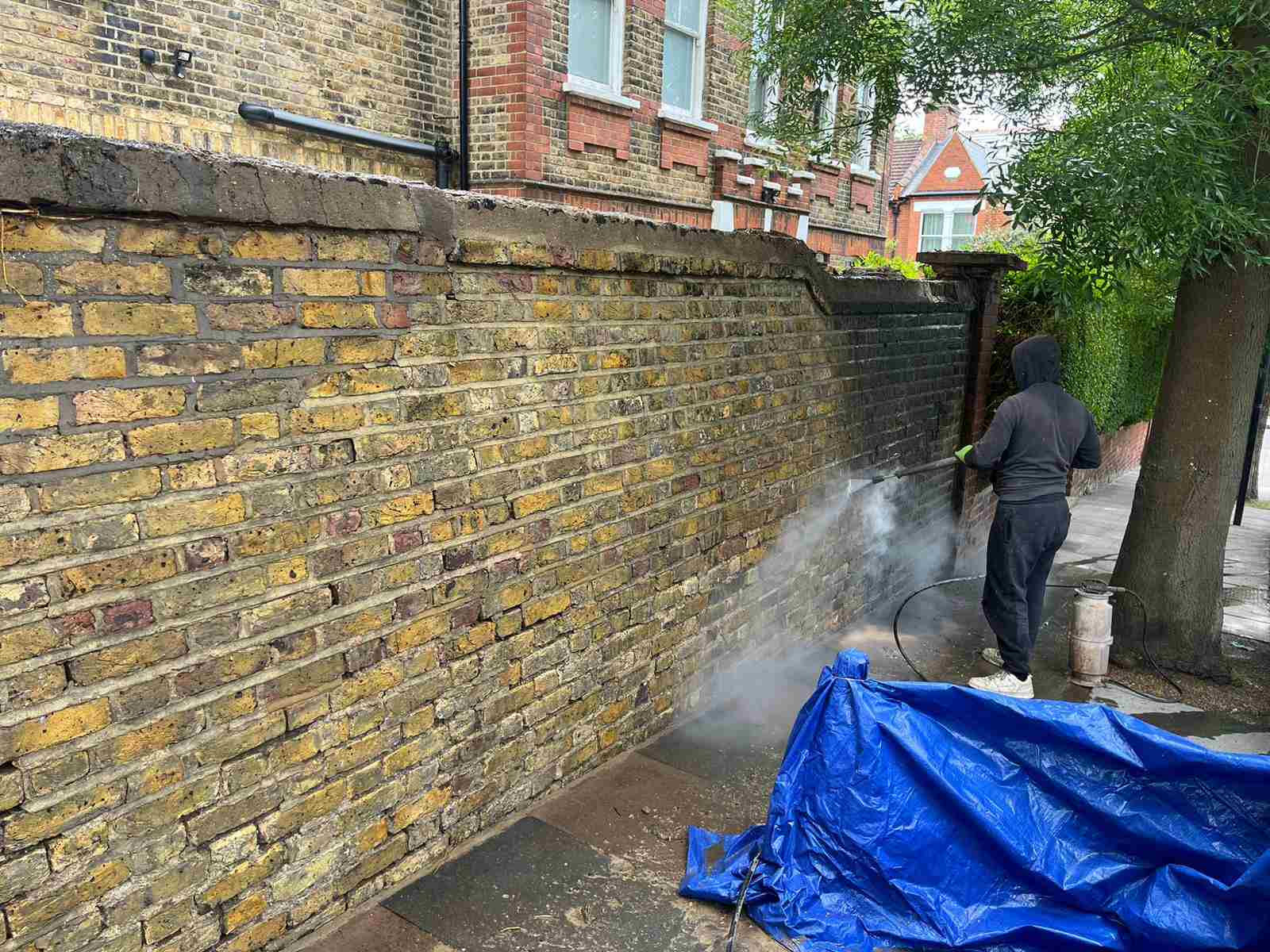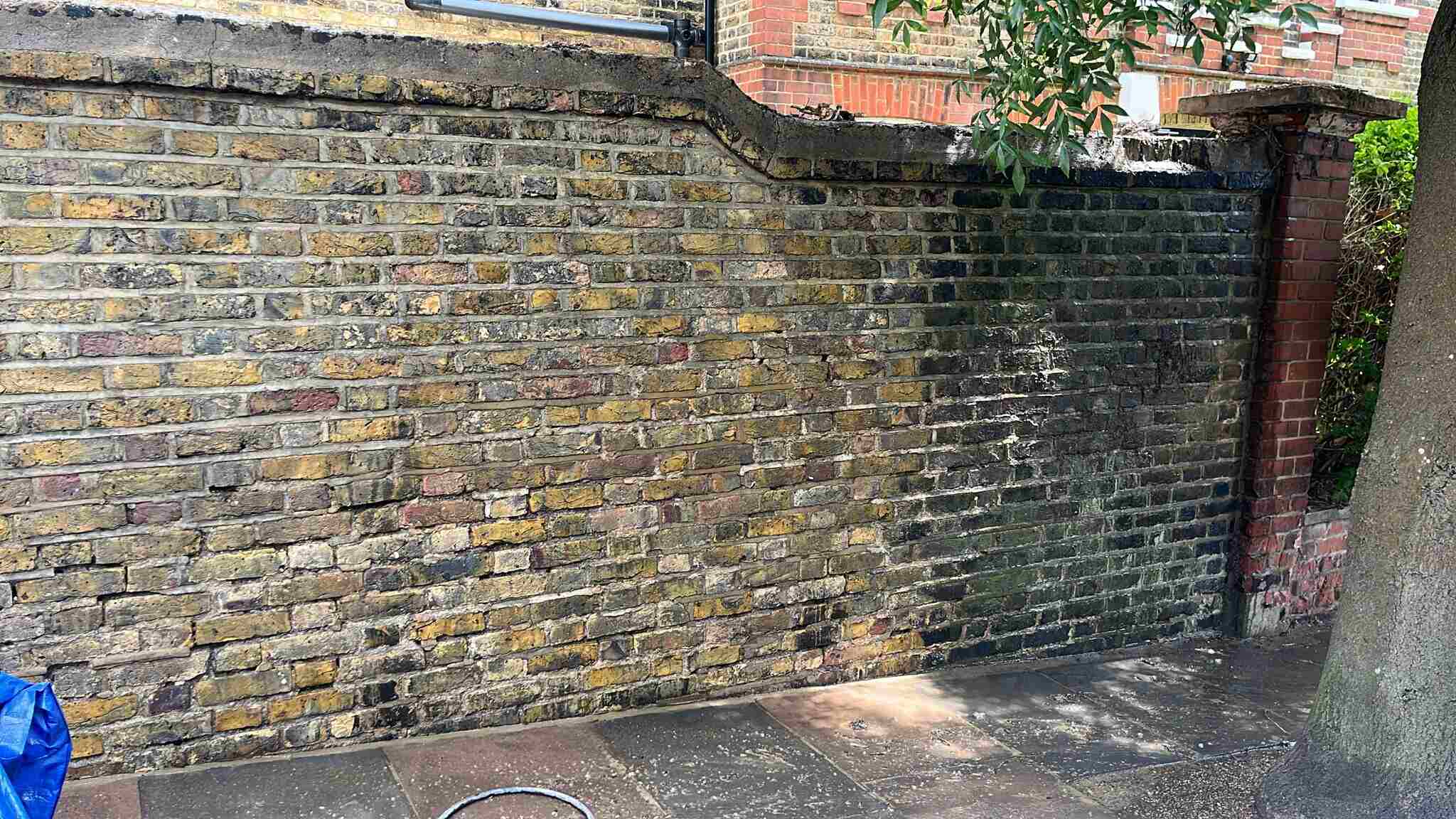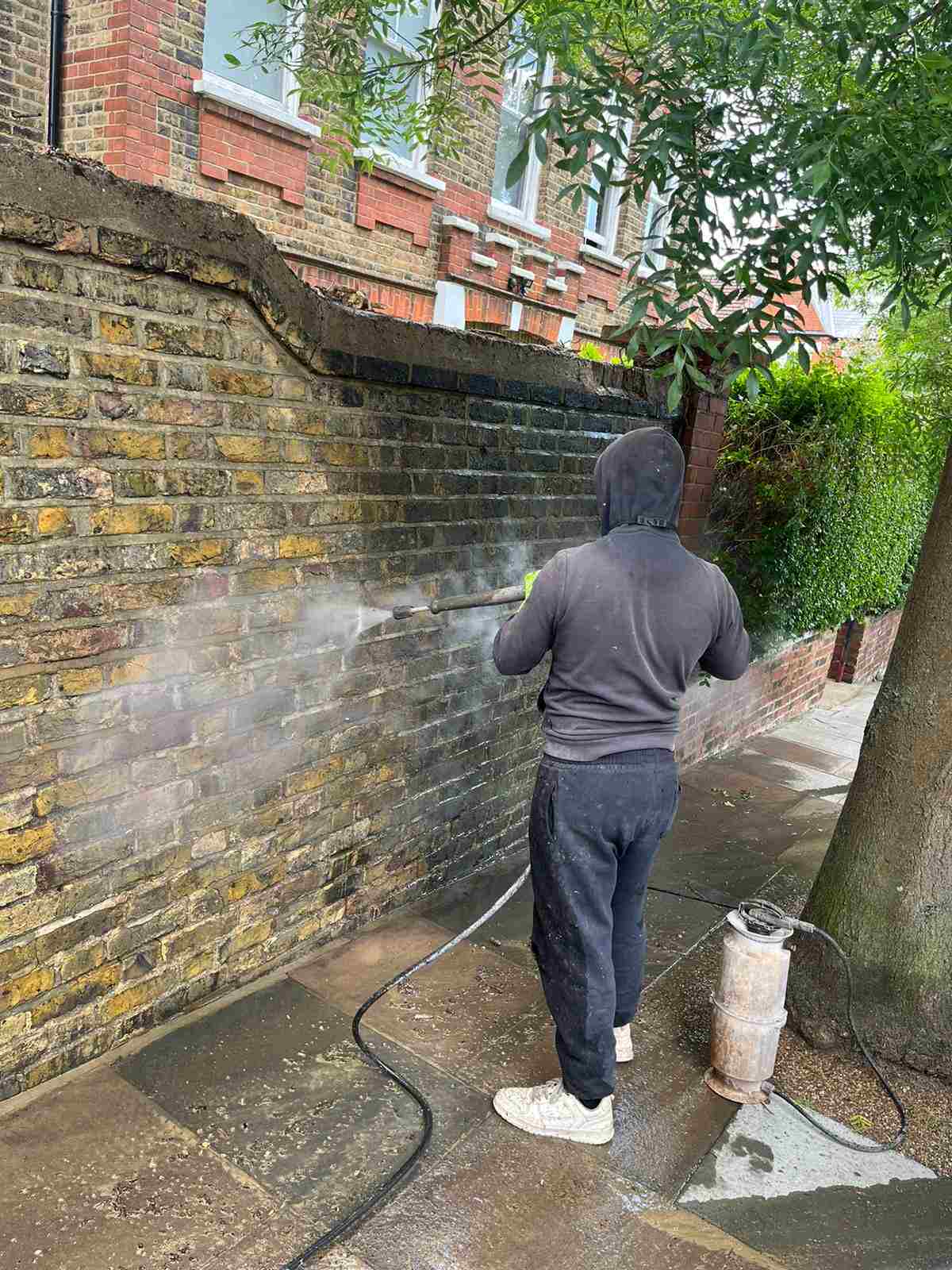
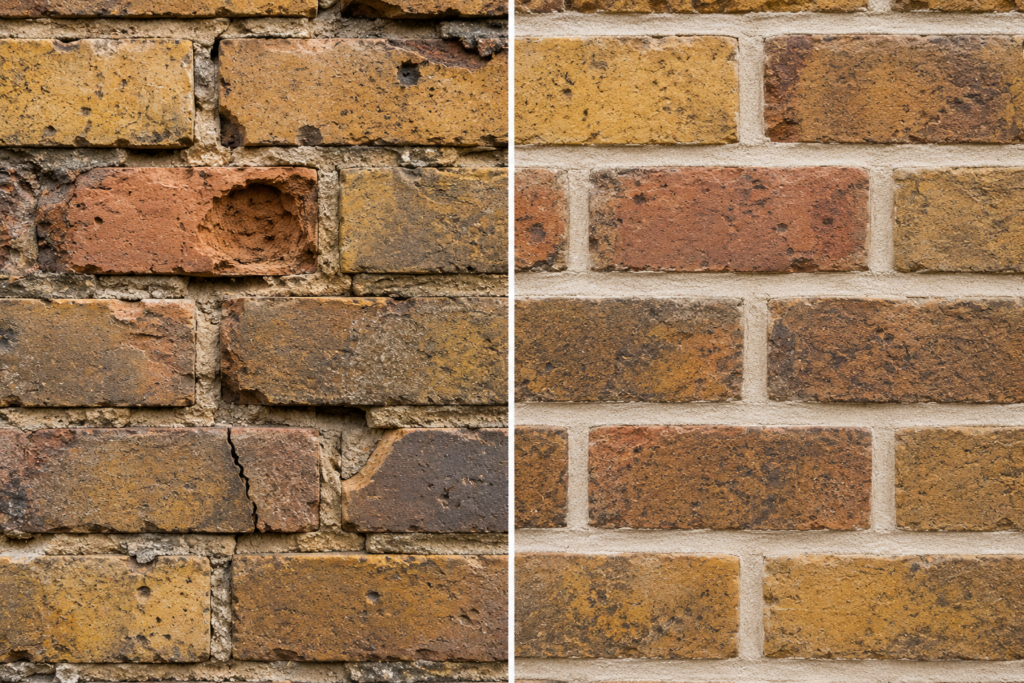
Damaged brickwork does not automatically mean the bricks need to be replaced.
On many London properties—particularly Victorian, Georgian and Edwardian buildings—the best restoration approach is often to retain as much original masonry as practical, repair localised damage and replace only those bricks that are too deteriorated to remain serviceable.
But how do you know when a brick can be repaired and when replacement is the better option?
As a general rule:
Minor surface deterioration, small chips, shallow spalling and localised cosmetic damage may sometimes be suitable for specialist brick repair. Bricks that are deeply spalled, badly cracked, loose, structurally fractured or significantly deteriorated may need to be carefully removed and replaced.
The decision should also consider why the brick failed in the first place.
Replacing a damaged brick without addressing a leaking gutter, hard cement mortar, trapped moisture or structural movement can simply allow the same problem to happen again.
Historic England’s conservation principles emphasise retaining as much significant historic fabric as possible and avoiding unnecessary replacement. Repairs should follow investigation of the cause and condition of the material rather than simply replacing old masonry because it looks weathered.
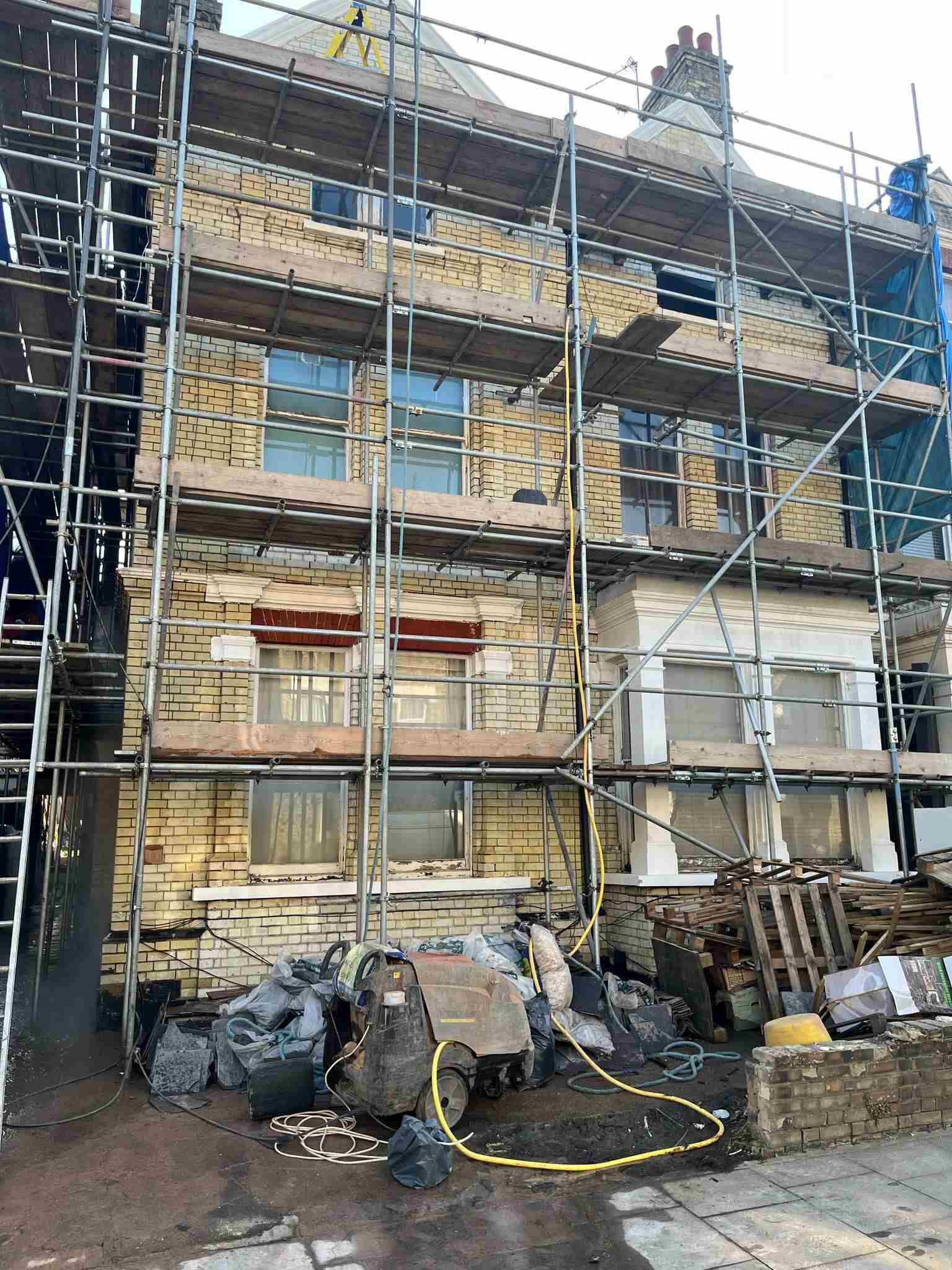
At DW Brickwork Restoration, damaged brickwork is assessed as part of the complete façade so the most appropriate repair, replacement and repointing strategy can be selected.
Internal link: Link “professional brick restoration in London” to:
What Causes Bricks to Become Damaged?
Before deciding between brick repair and replacement, it is important to understand what caused the deterioration.
Common causes include:
- Water penetration
- Freeze-thaw cycles
- Leaking gutters
- Damaged downpipes
- Hard cement mortar
- Salt crystallisation
- Structural movement
- Corroding metalwork
- Poor previous repairs
- Inappropriate paint or coatings
- Age and weather exposure
SPAB identifies continuous saturation, frost action, salt crystallisation, inappropriate cement mortar and structural movement among the common causes of deterioration in old brick walls.
Treating the cause is often just as important as repairing the visible brick.
What Is Brick Repair?
Brick repair means restoring a damaged brick while leaving most or all of the original masonry unit in place.
Depending on the type of damage, this may involve:
- Removing loose material
- Cleaning the damaged area
- Applying compatible repair material
- Rebuilding a lost brick face
- Colour and texture matching
- Repairing surrounding mortar
- Addressing moisture or pointing defects
Brick repair can be particularly valuable on period properties because it retains more original material.
This follows the wider conservation principle of using the minimum intervention necessary to keep historic fabric serviceable.
What Is Brick Replacement?
Brick replacement involves carefully removing a damaged brick and installing another suitable brick in its place.
The replacement should ideally match the existing masonry in:
- Size
- Colour
- Texture
- Porosity
- Strength
- Age or visual character
Matching is not only about appearance.
Historic England advises that new and existing bricks should be compatible so they weather in a similar way as well as look appropriate.
For Victorian and Georgian façades, reclaimed or specially matched bricks may sometimes provide a better result than inserting a bright modern brick into historic masonry.
Brick Repair vs Brick Replacement: Quick Comparison
| Condition | Repair May Be Suitable | Replacement May Be Better |
| Minor surface chip | ✓ | |
| Small cosmetic defect | ✓ | |
| Shallow spalling | ✓ | Sometimes |
| Localised face loss | ✓ | Sometimes |
| Deep spalling | ✓ | |
| Brick badly cracked through | ✓ | |
| Brick loose or unstable | ✓ | |
| Large section missing | ✓ | |
| Severe frost damage | Sometimes | ✓ |
| Brick crushed or structurally fractured | ✓ | |
| Historic brick with minor wear | ✓ | |
| Replacement would cause unnecessary loss of original fabric | ✓ |
This is only a guide.
A professional inspection is needed because similar-looking damage can have different causes.
1. Minor Chips and Surface Damage
Small chips around brick edges do not automatically justify replacement.
Old brickwork naturally develops:
- Minor imperfections
- Weathering
- Tool marks
- Small chips
- Colour variations
Trying to replace every imperfect brick on a Victorian façade could remove a large amount of original historic material unnecessarily.
Where the brick remains structurally sound and the defect is mainly cosmetic, a sympathetic repair—or sometimes simply leaving the historic wear alone—may be preferable.
2. Shallow Spalling
Spalling is the loss or flaking of the outer face of a brick.
It often occurs when moisture within the masonry freezes or when salts crystallise within the porous material.
Historic England explains that moisture trapped in soft masonry can contribute to freeze-thaw damage and spalling.
If only a shallow section of the brick face has deteriorated, specialist repair may sometimes be possible.
The important question is:
How much sound brick remains underneath?
3. Deep Spalling
Deep spalling is more serious.
Signs include:
- Large sections of brick face missing
- Soft crumbling interior exposed
- Brick depth significantly reduced
- Continued deterioration
- Loss extending close to mortar joints
In these circumstances, replacement may provide a more durable solution.
Ubersuggest currently shows:
spalled brick repair — 140 UK searches/month, SD 13
and
spalling brick repair — 90/month
making this an important supporting topic for the article.
What Causes Spalling Brick?
Common causes include:
Freeze-Thaw Action
Moisture enters porous brick.
When temperatures fall, water freezes and expands.
Repeated cycles can gradually break the brick surface apart.
Trapped Moisture
Dense:
- Paint
- Sealants
- Cement render
- Hard pointing
can sometimes restrict moisture movement in traditional masonry.
Historic England notes that relatively impermeable coatings can trap salts within masonry, which may then crystallise beneath the surface and cause spalling or exfoliation.
Hard Cement Mortar
Traditional brickwork often relies on mortar acting as the softer, sacrificial part of the wall.
If mortar is significantly harder than the surrounding bricks, moisture and weathering stresses may affect the bricks instead.
4. Cracked Bricks
Cracked bricks require more investigation because the cause matters enormously.
A small isolated crack may result from:
- Local impact
- Previous drilling
- Minor historic movement
A larger crack may indicate:
- Structural movement
- Lintel failure
- Wall-tie corrosion
- Settlement
- Subsidence
Historic England recommends seeking structural advice where walls are cracking, bulging or leaning or where masonry units are fracturing.
When Brick Replacement May Be Necessary
Replacement may be appropriate when a brick:
- Has cracked completely through
- Is separating into multiple pieces
- Is loose
- Has lost structural integrity
But replacing the brick alone is not enough if structural movement caused the crack.
5. Crumbling Bricks
A brick that is gradually turning soft and powdery requires closer assessment.
Possible causes include:
- Under-fired historic brick
- Long-term saturation
- Salt attack
- Frost
- Inappropriate cleaning
- Previous chemical treatment
Historic England identifies crumbling of very soft or under-fired bricks as one of the repair issues found in older solid brick walls.
If deterioration is limited to a small surface area, repair may remain possible.
Where the entire brick has become friable, replacement may be more appropriate.
6. Broken Brick Faces
Sometimes most of the brick remains sound but the visible face is damaged.
This is common after:
- Render removal
- Pebble dash removal
- Paint stripping
- Aggressive cleaning
- Previous construction work
A specialist brick-face repair may be appropriate where sufficient sound original material remains.
This can be especially useful where replacing the original brick would unnecessarily disturb adjacent historic masonry.
7. Loose Bricks
Loose bricks usually indicate a wider masonry problem.
Potential causes include:
- Failed mortar
- Structural movement
- Water damage
- Missing joints
- Previous poor repairs
The repair may require:
brick reset or replacement + repointing + correction of the underlying cause
rather than applying filler to the brick itself.
8. Damage Around Windows and Doors
Cracks and damaged bricks around openings deserve particular attention.
Possible causes include:
- Failed lintels
- Corroding steel
- Structural movement
- Altered openings
Rusting embedded metal can expand and create pressure inside masonry.
Historic England warns that corroding metal components can cause cracking and spalling and that distressed lintels should be professionally assessed.
Simply replacing the visible cracked bricks will not solve a failing lintel.
9. Hard Cement Repairs Around Soft Bricks
One pattern frequently seen on older London buildings is:
hard cement mortar remaining intact while the brick faces deteriorate around it.
This can indicate incompatible previous repairs.
If the mortar is much harder and less permeable than the brick, the masonry may become the more vulnerable element.
Before repairing or replacing bricks, the surrounding pointing should therefore be assessed.
When Should a Brick Be Repaired Instead of Replaced?
Repair is often worth considering where:
- Damage is relatively shallow
- The brick remains structurally sound
- Original historic fabric is valuable
- Matching replacement brick would be difficult
- Removing the brick may damage neighbouring masonry
- The defect can be repaired compatibly
Historic England’s conservation guidance supports retaining significant historic material wherever practical rather than replacing it unnecessarily.
When Should a Brick Be Replaced?
Replacement becomes more likely where:
- The brick has fractured completely
- Significant material is missing
- Deep spalling has occurred
- The brick is unstable
- The entire unit has become soft
- Structural performance is compromised
- Repair would not provide sufficient durability
The decision should be based on condition, not simply appearance.
Do All Spalled Bricks Need Replacement?
No.
This is an important point.
A brick with minor face loss may still have decades of serviceable life.
Replacing every spalled brick may:
- Remove historic fabric
- Increase cost
- Disturb surrounding mortar
- Create visual patchiness
SPAB advocates selective repair to old brick walls rather than wholesale intervention where possible.
What Is Brick Repair Mortar?
Specialist brick-repair materials can sometimes be used to recreate missing surface areas.
The repair material should ideally be compatible with the host brick in:
- Porosity
- Strength
- Texture
- Colour
It should not be significantly harder than the brick around it.
A repair that looks perfect on day one but traps moisture or weathers differently may create future problems.
This is particularly important with softer historic brick.
Should You Use Brick Repair Filler?
Ubersuggest shows “brick repair filler” at approximately 880 UK searches/month.
However, much of that is DIY/product shopping intent, rather than specialist restoration intent.
For a small cosmetic defect on modern masonry, proprietary repair products may have suitable applications.
For Victorian or historic façades, product selection requires more care.
The aim should be compatibility—not simply choosing a tube or filler with approximately the same colour.
This is why DW should mention brick repair filler in the article but not optimise the entire post around it.
What About Colour Matching?
Colour matching is essential in successful brick repair.
The contractor should consider:
- Base brick colour
- Fired variations
- Weathering
- Aggregate texture
- Surface roughness
- Mortar colour
A perfectly uniform replacement brick can actually look more obvious than a slightly varied one on a Victorian façade.
Original London stock bricks naturally contain considerable variation.
How Are Replacement Bricks Matched?
A suitable replacement should consider more than colour.
Size
Historic brick sizes can differ from modern standard bricks.
Texture
Machine-made modern brick may look noticeably different next to handmade masonry.
Porosity
The replacement should respond to moisture similarly to adjacent masonry.
Strength
An excessively hard replacement may weather differently.
Colour
Natural variation should be considered rather than matching one isolated brick.
Historic England recommends matching replacement bricks closely to original masonry both visually and technically.
Reclaimed Bricks vs New Bricks
Both may be appropriate.
Reclaimed Bricks
Can offer:
- Natural weathering
- Historic size
- Authentic texture
However, their:
- Strength
- Condition
- Salt content
- Previous exposure
should be considered.
New Matching Bricks
Specialist manufacturers can sometimes produce convincing matches.
Historic England conservation projects have even used specially commissioned bricks where appropriate to match important historic fabric.
The best choice depends on the building.
Do Replacement Bricks Need Lime Mortar?
On many historic buildings, yes—but not automatically.
The replacement mortar should be compatible with the:
- Existing brick
- Original mortar
- Building age
- Exposure
Many Victorian and Georgian London properties originally used lime-based mortar.
Should You Fix the Cause Before Replacing the Brick?
Absolutely.
This is one of the most important principles in the article.
If brick damage resulted from:
leaking gutter → saturated brick → frost → spalling
then replacing the brick without fixing the gutter simply exposes the new brick to the same conditions.
Historic England’s repair principles state that effective repair requires understanding why the material is failing and addressing the cause of deterioration.
Always investigate:
- Gutters
- Downpipes
- Roofs
- Flashing
- Ground levels
- Mortar
- Paint
- Render
- Structural movement
before treating visible damage alone.
Brick Repair vs Repointing
These are different services.
Brick Repair
Treats the masonry unit itself.
Repointing
Replaces deteriorated mortar joints.
Many restoration projects need both.
For example:
spalled brick + eroded lime mortar
may require:
brick repair/replacement + lime mortar repointing
Brick Repair After Paint Removal
Removing paint can reveal hidden:
- Chips
- Spalling
- Previous brick repairs
- Cracks
- Cement patches
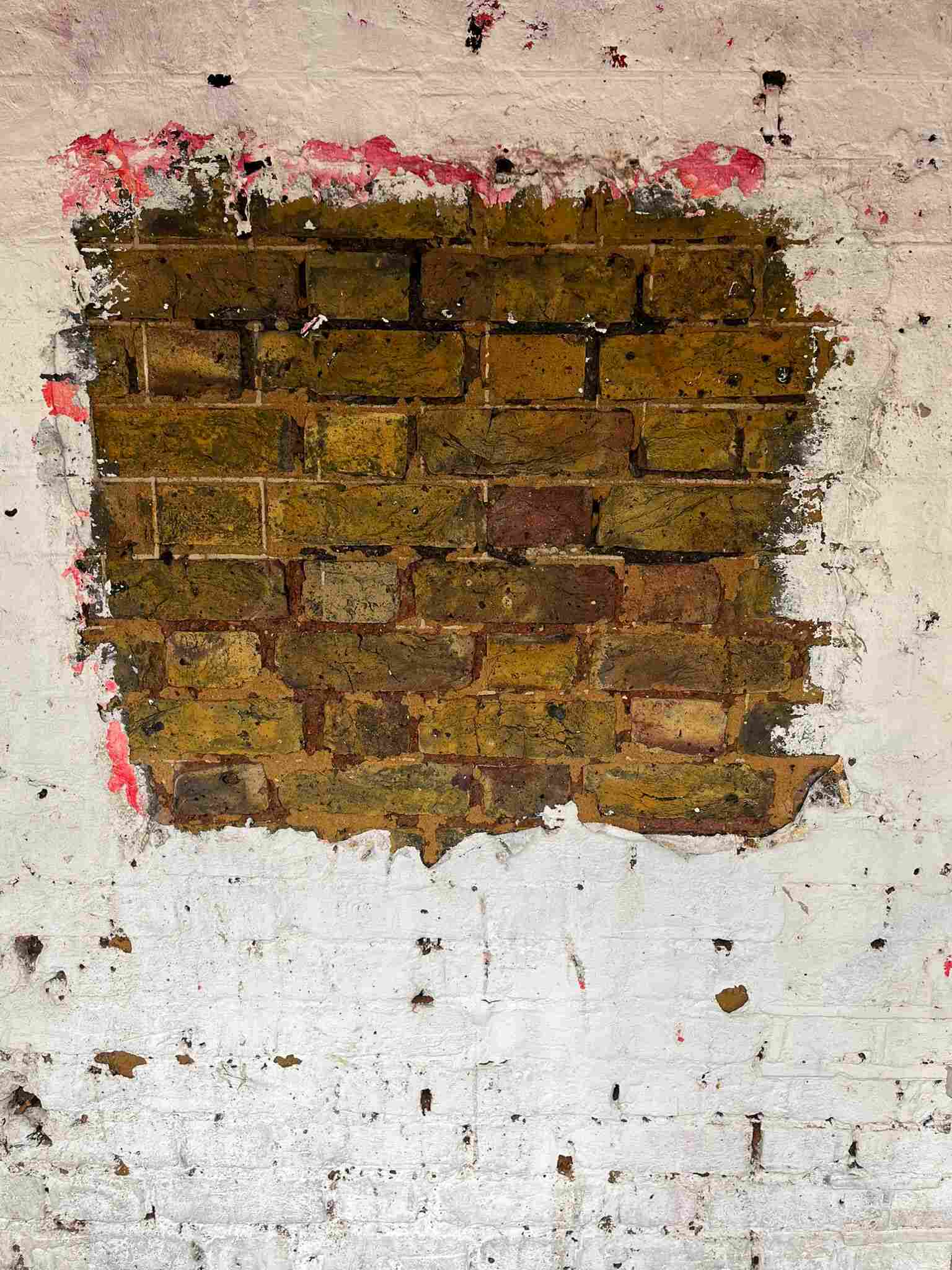
The brick should be assessed after stripping before deciding how much restoration is required.
Brick Repair After Render or Pebble Dash Removal
This is another common scenario.
Render may have hidden the masonry for decades.
Once removed, the contractor may uncover:
- Broken brick faces
- Cement damage
- Old repairs
- Deteriorated mortar
Some bricks can be repaired.
Others may require replacement.
Brick Repair After Cleaning
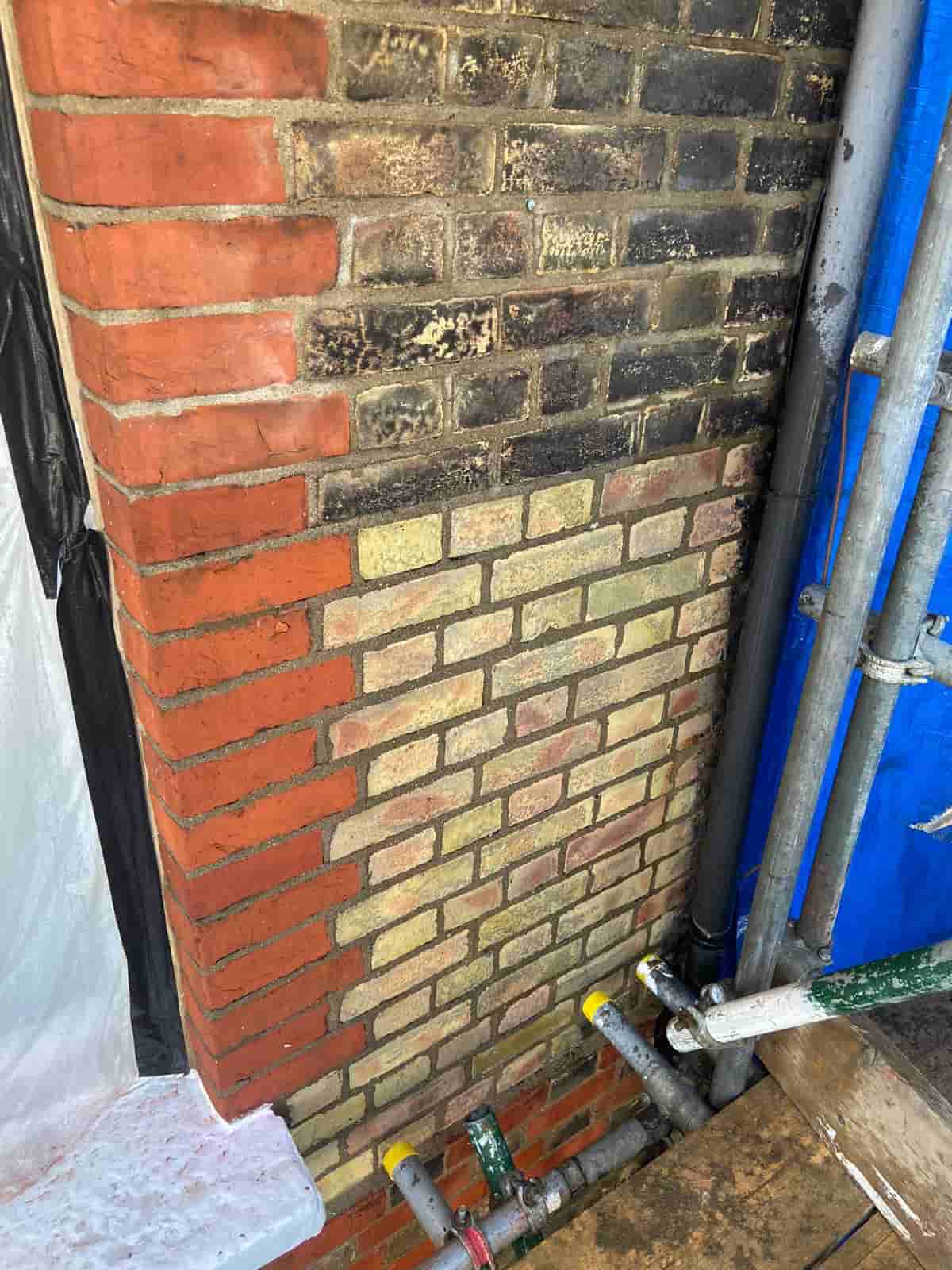
Professional cleaning sometimes reveals defects previously hidden beneath:
- Soot
- Pollution
- Moss
- Paint residue
The cleaning process should therefore be followed by inspection.
Does Brick Replacement Affect Property Appearance?
It can if matching is poor.
A row of bright new orange bricks inside a weathered yellow London stock façade can be extremely noticeable.
Poor repairs may stand out for decades.
Good restoration aims to create a repair that is:
- Compatible
- Durable
- Sympathetic
- Visually balanced
without pretending the historic façade was constructed yesterday.
Can Brick Repair Improve Property Value?
No responsible contractor can guarantee that repairing bricks will increase a property’s market value by a particular amount.
However, damaged masonry can create concerns for buyers.
Visible:
- Cracks
- Spalling
- Loose brickwork
- Damp staining
- Poor repairs
may suggest wider maintenance problems.
Well-maintained brickwork can therefore improve:
- Kerb appeal
- Building condition
- Buyer confidence
while helping prevent more expensive deterioration.
Is Brick Damage Structural?
Sometimes.
Most isolated surface damage is not necessarily structural.
However, specialist investigation is required when you see:
- Wide cracks
- Stepped cracking
- Bulging walls
- Leaning walls
- Repeated cracks
- Distorted openings
- Multiple fractured bricks
Historic England recommends structural-engineer advice where masonry is cracking, bulging or leaning.
Do not use cosmetic brick repair to hide unresolved structural movement.
Brick Repair on Victorian London Properties
Victorian masonry requires particular attention because it often contains:
- London stock brick
- Soft red brick
- Lime mortar
- Decorative arches
- Handmade materials
- Historic repairs
The restoration objective should usually be:
retain → repair → selectively replace
rather than:
remove → replace everything
This approach helps preserve the visual character of London’s period architecture.
Brick Repair Across London
DW Brickwork Restoration provides restoration services throughout:
- Central London
- North London
- South London
- East London
- West London
The company’s existing Brick Restoration London page already identifies:
- Cracked bricks
- Chipped bricks
- Eroded bricks
- Loose mortar
- Damp
- Bulging masonry
as warning signs that restoration may be required.
This blog should become the detailed educational resource behind that service page.
Why Choose DW Brickwork Restoration?
Brick repair should not be treated in isolation.
The condition of:
- Mortar
- Moisture
- Coatings
- Adjacent bricks
- Previous repairs
can all affect the correct solution.
DW Brickwork Restoration provides:
- Brick repair
- Brick restoration
- Brick cleaning
- Repointing
- Lime mortar pointing
- Paint removal
- Render removal
- Pebble dash removal
This makes it possible to assess the façade as a complete masonry system rather than replacing individual bricks without understanding why they failed.
Get a Brick Repair Assessment in London
If your brickwork is:
- Cracked
- Spalling
- Chipped
- Crumbling
- Loose
- Weather-damaged
a professional inspection can determine whether the bricks can be repaired or genuinely need replacing.
Preserve as Much Original Brickwork as Possible
Contact DW Brickwork Restoration for specialist brick repair and restoration throughout London.
Call: 07400 421 172
Email: info@dwbrickworkrestoration.co.uk
Request a free, no-obligation site assessment and quotation.