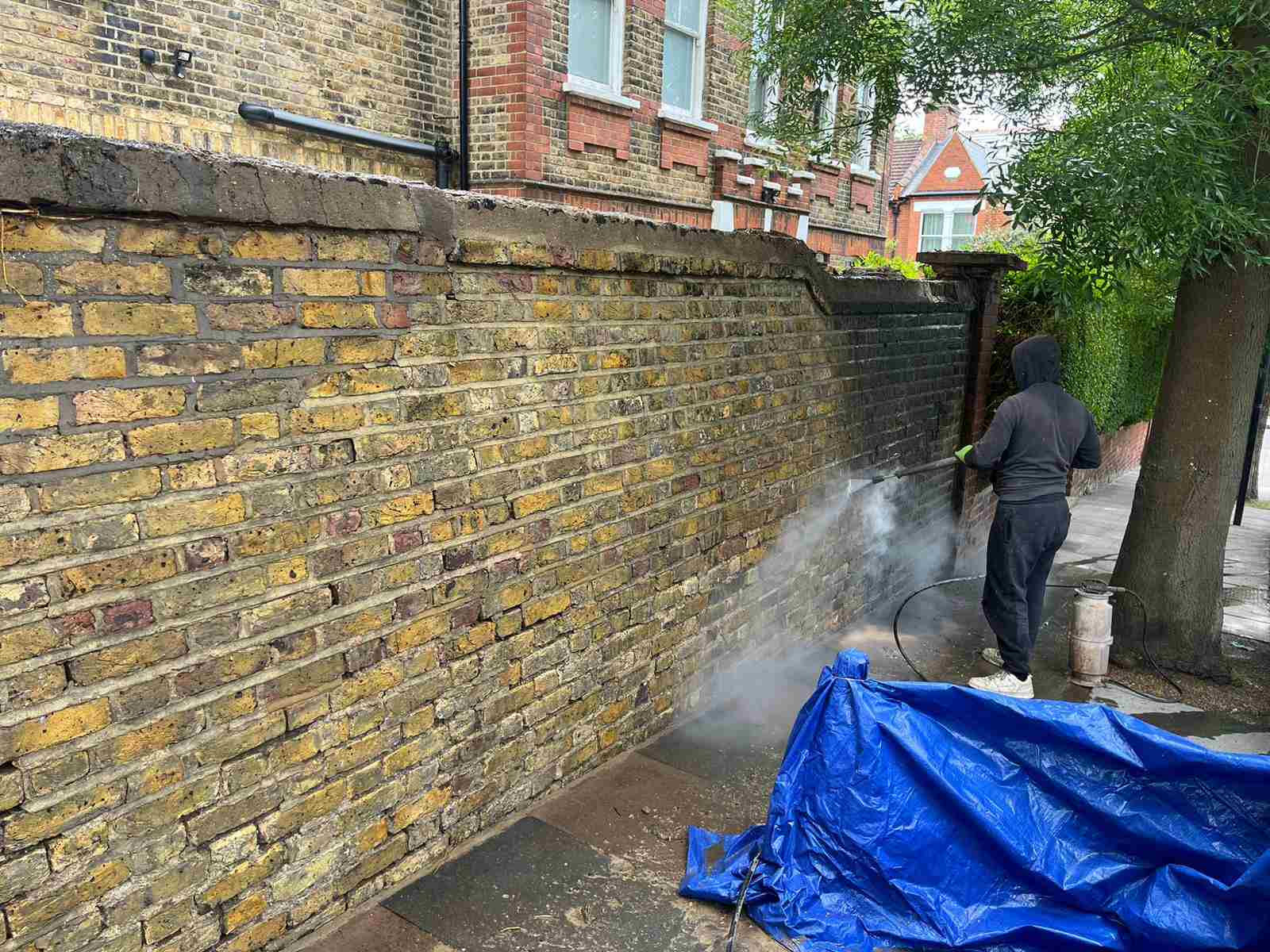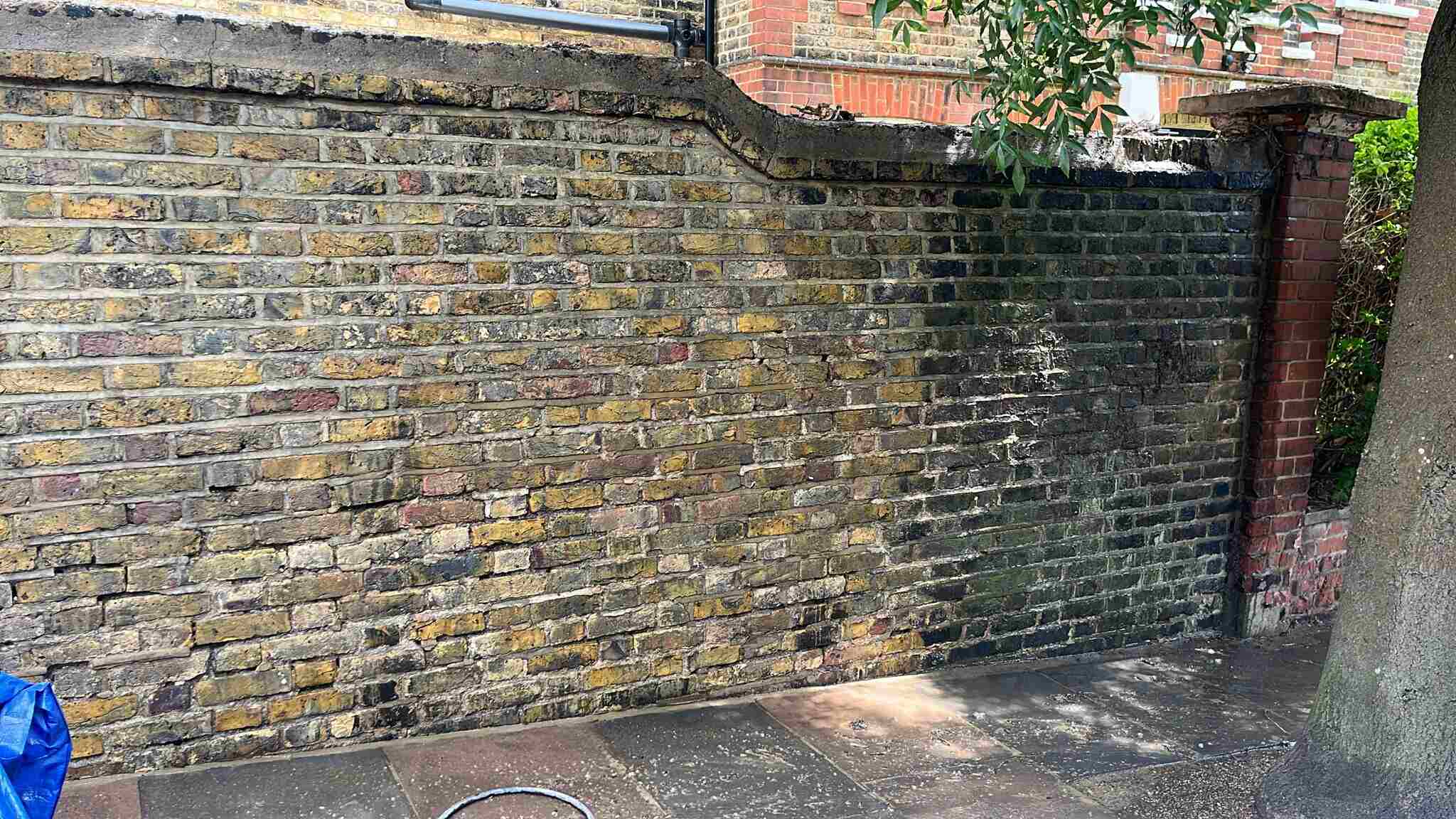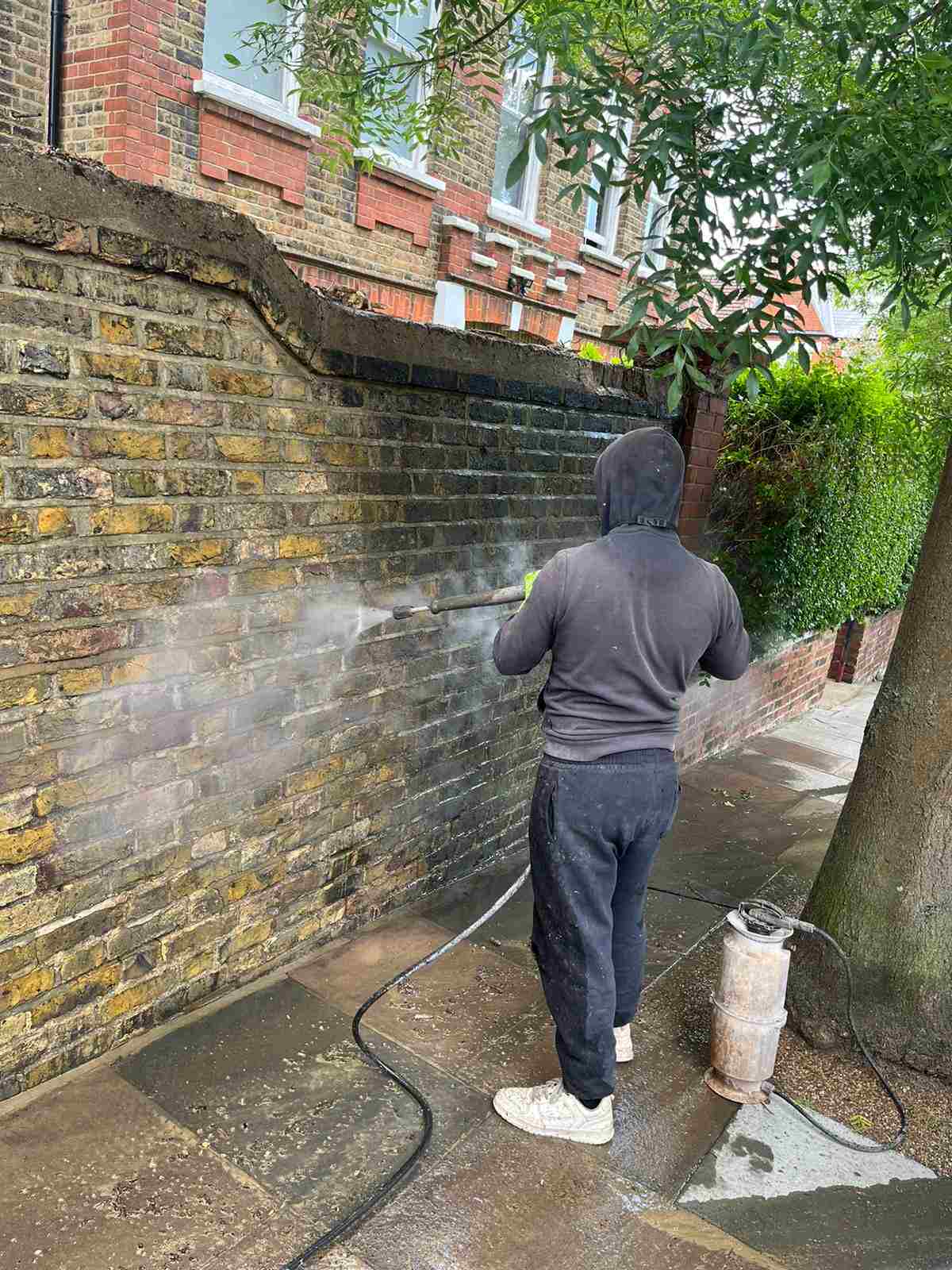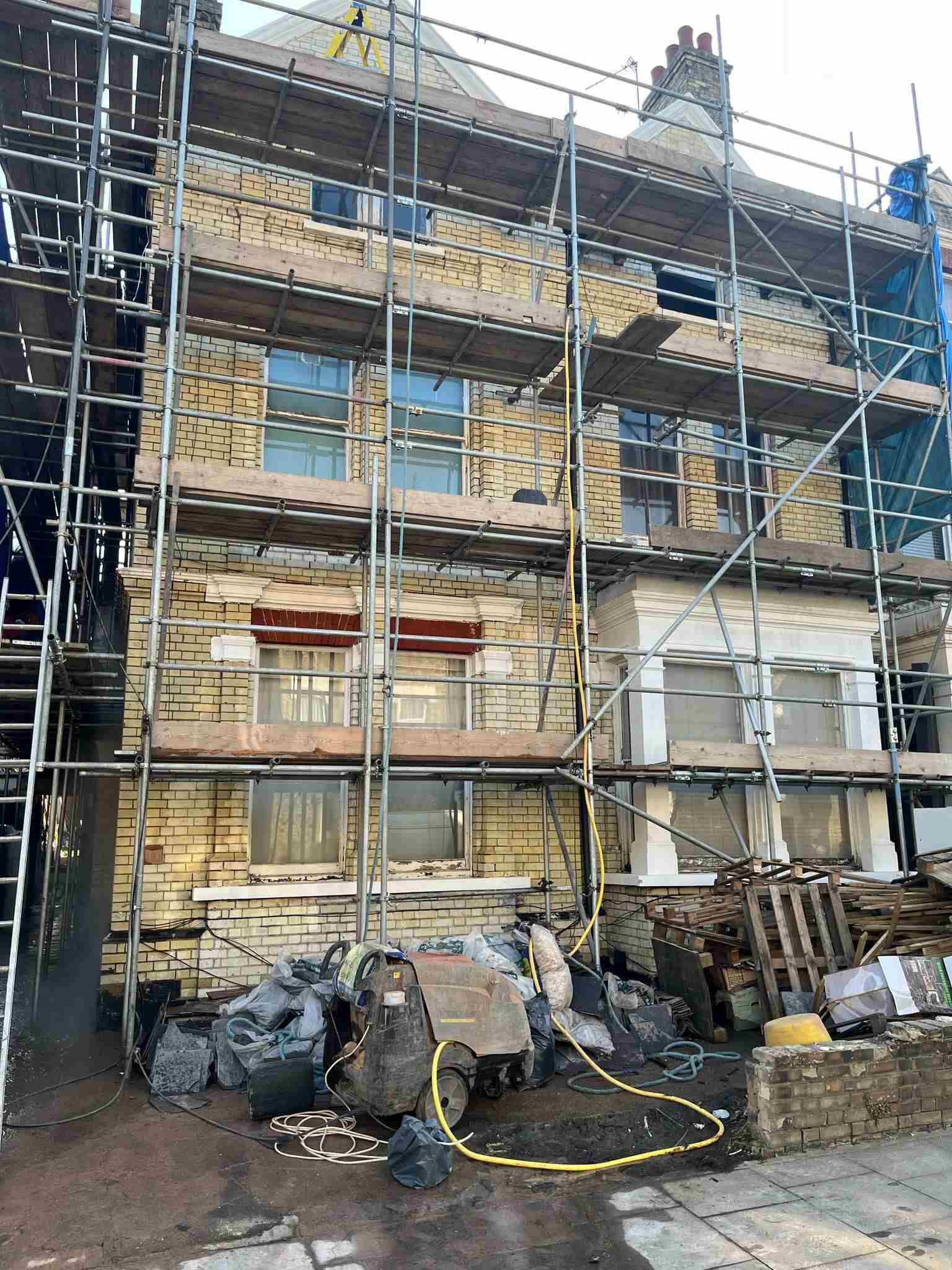
Cleaning old brickwork is not as simple as choosing the most powerful machine available.
London properties can contain soft Victorian stock bricks, harder modern masonry, lime mortar, decorative terracotta, stone details, decades of traffic pollution, algae, paint residue and heavy carbon deposits.
Using the wrong cleaning technique can permanently alter the surface.
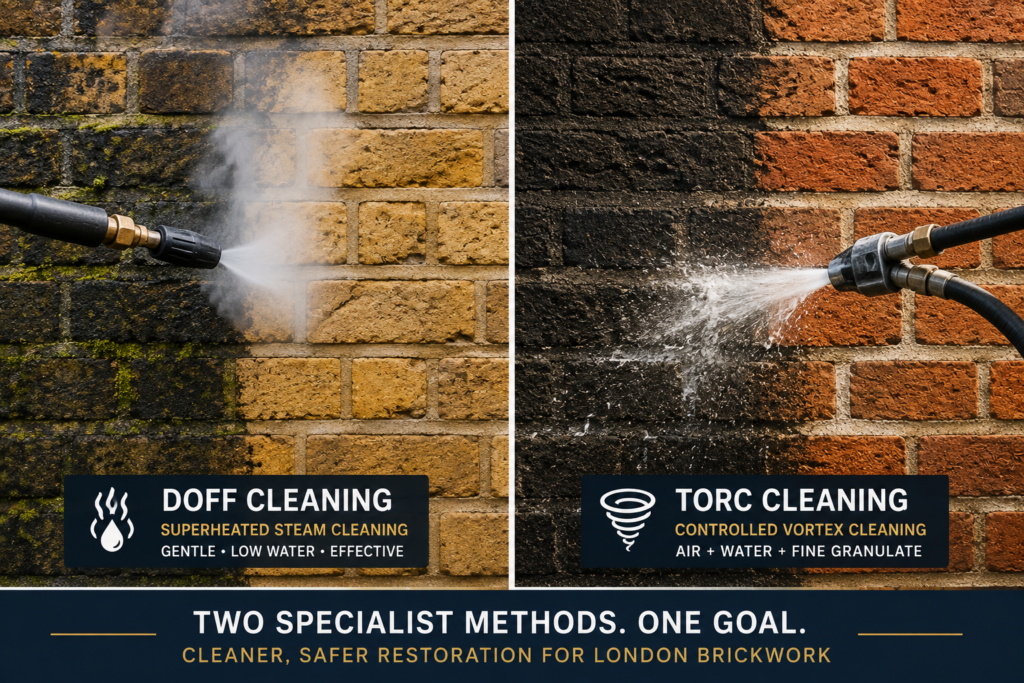
Two specialist systems frequently discussed in masonry restoration are DOFF cleaning and TORC cleaning.
But what is the difference between them—and which is best for London brickwork?
The short answer is:
DOFF uses superheated water and steam to clean masonry with heat and controlled pressure, while TORC uses a gentle swirling combination of air, water and fine inert granulate to remove more stubborn deposits.
Neither system is automatically “better.”
DOFF can be particularly effective for biological growth, general grime, some paints, oils and coatings, while TORC is commonly used for tougher carbon sulphation, brittle coatings, limescale and masonry residues. In some restoration projects, the two methods can even be used at different stages.
Stonehealth describes DOFF as a superheated water system capable of delivering temperatures up to approximately 150°C at the nozzle, while TORC creates a controlled vortex using air, low volumes of water and fine inert granulate.
For London property owners, the important question should therefore be:
What is the safest cleaning system for this particular brickwork and contamination?
At DW Brickwork Restoration, the age, condition and type of masonry should be assessed before choosing a cleaning technique.
DOFF is a specialist masonry-cleaning system that uses superheated water and steam.
What Is DOFF Cleaning?
Unlike conventional pressure washing, the cleaning effect relies heavily on temperature rather than simply increasing mechanical pressure.
Stonehealth states that the current DOFF system can reach temperatures of up to approximately 150°C at the nozzle, while allowing the operator to adjust temperature and pressure according to the surface being treated.
The high temperature can help loosen and remove contaminants while using relatively low volumes of water.
Typical DOFF applications include:
- Moss
- Algae
- Fungi
- Biological growth
- General dirt
- Atmospheric grime
- Bird fouling
- Oil and grease
- Wax
- Chewing gum
- Some paints
- Some graffiti
- Surface coatings
One of the main advantages is that the masonry is not normally saturated with the same volume of water associated with conventional pressure washing.
How Does DOFF Cleaning Work?
The process can be simplified into four stages.
1. Water Is Heated
Water passes through the DOFF system and is heated to very high temperatures.
2. Temperature and Pressure Are Controlled
The operator adjusts the settings according to:
- Brick type
- Surface condition
- Contamination
- Mortar condition
- Building age
This control is particularly important on older masonry.
3. Superheated Water Reaches the Surface
Heat helps loosen contamination.
Rather than relying solely on impact pressure, the process uses temperature to assist removal.
4. The Contamination Is Lifted Away
Dirt and unwanted material can then be removed from the surface with relatively low water usage.
Stonehealth notes that superheated steam can also kill spores associated with moss, algae and fungi during cleaning.
What Is TORC Cleaning?
TORC is another specialist masonry-cleaning system, but it works very differently from DOFF.
Instead of relying mainly on heat, TORC creates a swirling vortex of air, water and fine inert granulate.
The specially designed nozzle causes the granulate to move across the surface in a controlled vortex.
Stonehealth describes the system as using low volumes of water, fine inert granulate and air to produce a sensitive method of masonry cleaning.
TORC is frequently used to remove stubborn deposits such as:
- Carbon sulphation
- Black crusts
- Brittle paint
- Limescale
- Cement residue
- Lime residue
- Plaster residue
- Atmospheric pollution
- Certain oxidised coatings
- Persistent grime
Because the system contains a fine abrasive medium, control is essential.
TORC should not be confused with unrestricted sandblasting.
How Does TORC Cleaning Work?
TORC uses three principal components:
Air
Compressed air provides the energy required to move the cleaning medium.
Water
A relatively small quantity of water helps control dust and cleaning action.
Fine Granulate
A selected inert cleaning medium assists in removing deposits.
These pass through a specialised nozzle that creates a swirling vortex rather than directing abrasive material straight at the wall.
This allows a trained operator to progressively remove contamination while controlling the effect on the substrate.
DOFF vs TORC: Main Differences
| Feature | DOFF Cleaning | TORC Cleaning |
| Main cleaning action | Superheated water/steam | Swirling air, water and fine granulate |
| Uses abrasive medium | No | Yes, controlled fine granulate |
| Uses heat | Yes | No comparable superheated action |
| Biological growth | Excellent application | Can remove some build-up |
| General grime | Very suitable | Suitable |
| Carbon sulphation | May assist depending on deposit | Particularly useful |
| Paint | Useful for various paints/coatings | Useful particularly for brittle coatings |
| Cement/lime residue | Limited depending on deposit | Often more appropriate |
| Water usage | Relatively low | Very low |
| Historic masonry | Can be appropriate after testing | Can be appropriate with skilled control |
| Cleaning mechanism | Heat + controlled pressure | Gentle micro-abrasive vortex |
The actual choice should always depend on the wall rather than the table alone.
Which Is Better for Cleaning Brick?
Neither system wins universally.
DOFF may be preferable when dealing with:
- Moss
- Algae
- Fungal growth
- Organic matter
- General grime
- Oils
- Some paint coatings
- Sensitive surfaces where abrasion is undesirable
TORC may be preferable for:
- Heavy carbon deposits
- Carbon sulphation
- Brittle coatings
- Limescale
- Cement deposits
- Lime residues
- Stubborn atmospheric pollution
A professional test panel can determine which method delivers the required result while preserving the underlying brick.
Is DOFF Cleaning Safe for Old Brickwork?
It can be very suitable when used correctly.
The important point is that DOFF is controllable.
An experienced operator can adjust temperature and pressure according to the condition of the surface.
The technique is frequently selected where more aggressive mechanical cleaning would be inappropriate.
However, no cleaning system should automatically be described as “100% safe” for every brick.
Old brickwork may already be:
- Spalled
- Cracked
- Soft
- Salt contaminated
- Poorly fired
- Previously damaged
- Repaired using inappropriate mortar
The wall should therefore be assessed before work begins.
Is TORC Safe for Historic Brick?
TORC can be used on sensitive masonry, but the operator’s judgement is critical.
The system uses an abrasive medium, even though that medium is applied in a highly controlled swirling action.
Settings need to consider:
- Brick hardness
- Type of granulate
- Nozzle
- Air pressure
- Distance from surface
- Existing deterioration
- Desired cleaning level
The objective should be to remove contamination—not the historic surface of the brick.
This is one reason a test patch is essential.
Is TORC the Same as Sandblasting?
No.
This distinction is important.
Traditional sandblasting can involve abrasive media striking masonry aggressively at relatively high energy.
TORC instead uses a carefully controlled mixture of:
- Fine granulate
- Air
- Water
within a specialised vortex nozzle.
Stonehealth explicitly describes TORC as a sensitive masonry-cleaning method rather than a conventional blasting process.
That does not mean TORC cannot damage masonry if used incorrectly.
Any system that mechanically removes contamination requires skilled operation.
DOFF vs Pressure Washing
DOFF should also not be confused with ordinary pressure washing.
A standard pressure washer primarily depends on the mechanical impact of water.
DOFF combines controlled water delivery with high temperature.
That distinction matters on old bricks.
Historic England warns that excessive high-pressure water cleaning can roughen and damage masonry surfaces.
For traditional London properties, simply increasing pressure until a wall looks clean is not an appropriate conservation strategy.
What Can DOFF Remove From Brickwork?
DOFF can be useful for removing several forms of contamination.
Moss and Algae
This is one of the strongest applications.
The heat helps remove biological growth and can kill associated spores.
General Pollution
Surface grime and atmospheric pollution can often be softened and removed.
Paint
Certain paints and coatings can respond well to superheated cleaning.
However, thick or resistant coatings may first require a suitable paint-softening system.
Stonehealth describes paint removal from historic masonry as a process that may involve first softening the paint and then using controlled cleaning.
Grease and Oil
Heat can assist in breaking down greasy contamination.
Graffiti
Some types of graffiti can be treated using superheated steam, depending on:
- Paint type
- Substrate
- Age
- Porosity
A test area should be carried out first.
What Can TORC Remove?
TORC becomes especially useful where the deposit requires carefully controlled mechanical assistance.
Carbon Sulphation
Historic buildings in polluted cities can develop hard dark deposits.
TORC is particularly associated with removal of carbon sulphation from stone and masonry.
Black Atmospheric Crusts
Dense pollution deposits can sometimes remain after gentler surface cleaning.
TORC may provide the additional cleaning action required.
Brittle Paint
Some old, brittle paint coatings may respond well to controlled TORC treatment.
Cement and Lime Residue
Restoration projects often reveal:
- Cement smears
- Lime deposits
- Plaster residue
TORC can be useful where those residues are bonded too strongly for straightforward steam cleaning.
What Is Carbon Sulphation?
Carbon sulphation is commonly associated with dark crusts found on historic masonry exposed to polluted urban environments.
London’s long industrial history and traffic pollution have left many buildings with stubborn black deposits.
The contamination can become particularly pronounced:
- Under cornices
- Around architectural details
- In sheltered areas
- On stone detailing
- Around window features
These deposits can sometimes require a different approach from general soot or surface grime.
That is where TORC can become useful.
Can DOFF Remove London Pollution?
Yes, depending on the type and severity of pollution.
DOFF can be very effective for:
- Surface grime
- Organic material
- General atmospheric soiling
- Traffic film
For deeply embedded carbon deposits, another method may be required.
A particularly useful example comes from restoration work at Birmingham Municipal Bank, where contractors first used DOFF for superficial grime and biological material before using TORC selectively for stubborn carbon staining and residual deposits.
That illustrates an important point:
DOFF and TORC do not always compete with one another—they can complement one another.
Can DOFF and TORC Be Used Together?
Yes.
Some restoration projects use a staged cleaning process.
For example:
Stage 1 — DOFF
Remove:
- General grime
- Biological material
- Loose contamination
- Surface pollutants
Stage 2 — Inspect
Once the masonry is cleaner, remaining contamination becomes easier to identify.
Stage 3 — Targeted TORC
Apply TORC only where stubborn:
- Carbon
- Mineral residue
- Cement contamination
- Brittle coating
remains.
This approach can avoid unnecessarily abrasive treatment across the entire façade.
Why Test Cleaning Is So Important
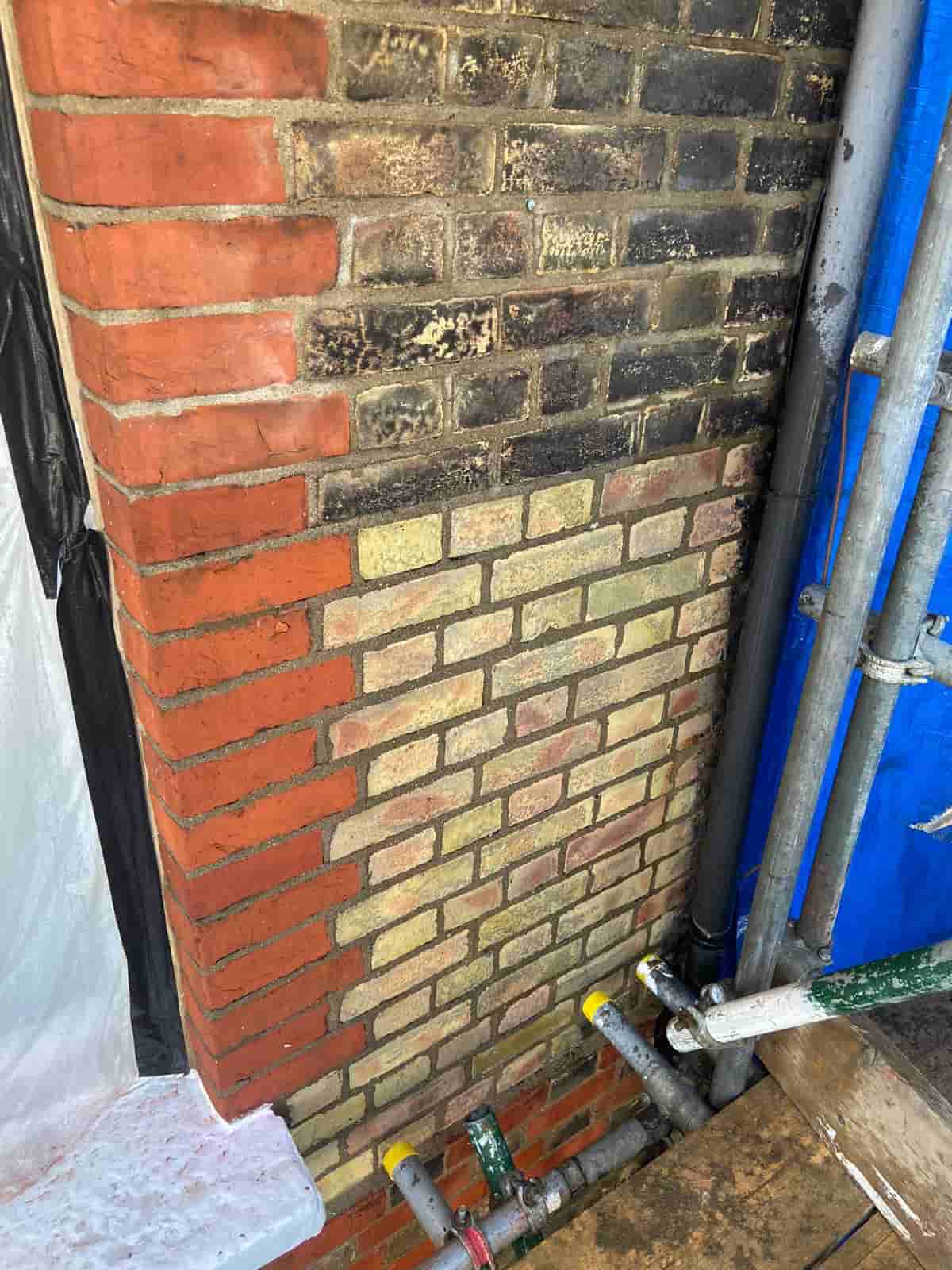
A test panel allows the cleaning contractor and property owner to see the result before committing to a complete façade.
Testing helps establish:
- How clean the brick can realistically become
- Whether the brick surface is stable
- Which method works best
- Whether staining is superficial or embedded
- Whether mortar becomes vulnerable
- What finish should be expected
Historic masonry should not necessarily be cleaned until it looks brand new.
Excessive cleaning can remove:
- Historic patina
- Fired brick surface
- Natural colour variation
- Fine architectural detail
The goal should be appropriate cleaning, not maximum cleaning.
Should Old Brickwork Look New After Cleaning?
Usually not.
Victorian London stock bricks naturally display:
- Colour variations
- Fired markings
- Ageing
- Texture
- Weathering
- Historic imperfections
An overly uniform façade can look artificial.
More importantly, achieving that appearance may require removing part of the original brick surface.
Good restoration should reveal the original material while retaining its character.
DOFF Cleaning for Victorian Houses
Victorian houses are one of the strongest applications for careful specialist cleaning.
A typical Victorian façade may contain:
- London stock bricks
- Lime mortar
- Stone window details
- Decorative arches
- Terracotta
- Previous cement repairs
Different parts of the same building may therefore respond differently.
DOFF may be used to remove:
- Pollution
- Moss
- Algae
- Dirt
- Some coatings
while particularly stubborn deposits may require another treatment.
TORC Cleaning for Victorian and Historic Buildings
TORC may be considered where conventional gentle cleaning has left persistent contamination.
Possible applications include:
- Heavy black crusts
- Carbon sulphation
- Brittle historic paint
- Cement staining
- Mineral deposits
However, softer bricks require especially careful testing.
TORC settings that are appropriate for hard stone may not necessarily be appropriate for a softer London stock brick.
Which Method Is Best for Listed Buildings?
There is no single system approved for every listed building.
The correct cleaning specification should consider:
- Significance of the surface
- Brick or stone type
- Existing condition
- Type of contamination
- Historic coatings
- Conservation requirements
Where a listed building is involved, cleaning that materially alters its appearance may require conservation input or consent.
The safest approach is usually:
survey → test clean → agree acceptable finish → proceed carefully
rather than specifying equipment before examining the building.
Does Brick Cleaning Damage Mortar?
It can if inappropriate methods are used.
Old lime mortar may be considerably softer than the surrounding brickwork.
Cleaning therefore needs to consider both materials.
Potential warning signs include:
- Loose joints
- Deeply recessed mortar
- Powdering lime mortar
- Hard cement patches
- Open cracks
Where mortar has genuinely failed, repointing may need to be incorporated into the restoration.
Should Brickwork Be Cleaned Before or After Repointing?
The correct sequence depends on the project.
Cleaning first can reveal:
- Defective joints
- Hidden brick damage
- Previous repairs
- Colour variations
However, severely open mortar joints may need temporary or permanent attention before extensive wet cleaning.
The masonry should be considered as a complete system.
How Much Does DOFF Cleaning Cost?
Ubersuggest currently shows meaningful UK search interest around:
DOFF cleaning cost per m²
Pricing depends on:
- Surface area
- Building height
- Access
- Scaffolding
- Contamination
- Brick condition
- Required temperature
- Number of passes
- Additional restoration work
For the broader brick-cleaning pricing discussion, readers should be linked to:
Blog #2 — Brick Cleaning Cost London 2026: Prices Per m² & What Affects the Cost
That prevents this page from competing with the main cost guide.
Is DOFF Cleaning Chemical-Free?
DOFF itself uses heated water rather than relying on a chemical cleaning agent.
That can make it useful where reducing chemical treatments is desirable.
However, some projects—particularly paint removal—may require an appropriate coating softener or additional treatment before DOFF cleaning.
Therefore it is more accurate to say:
DOFF can clean many forms of contamination without chemical cleaning agents, but not every project is completely chemical-free.
Is TORC Chemical-Free?
The TORC cleaning action itself uses:
- Air
- Water
- Fine inert granulate
rather than a chemical cleaning agent.
This can be advantageous for suitable restoration projects.
Again, surrounding project requirements may still involve other treatments depending on the contamination.
DOFF vs TORC for Paint Removal
The correct system depends heavily on the paint.
DOFF May Be Suitable For
- Flexible coatings
- Heat-responsive coatings
- Softened paint
- Some graffiti
TORC May Be Suitable For
- Brittle coatings
- Resistant surface residues
- Certain old paint deposits
Sometimes the most effective solution involves paint softening followed by controlled cleaning.
Internal link: Blog #3 — Brick Paint Removal: Best Ways to Remove Paint From Brick Without Damage
DOFF vs TORC for Render or Pebble Dash Residue
After render or pebble dash removal, the bricks underneath may retain:
- Cement
- Mortar residue
- General grime
DOFF can help clean pollution and surface contamination.
TORC may be considered for persistent mineral or cement residues where the substrate is suitable.
Specialist Brick Cleaning in London
London masonry experiences several challenging conditions:
- Traffic pollution
- Historical soot
- Biological growth
- Moisture
- Previous paint coatings
- Cement repairs
- Atmospheric grime
DW Brickwork Restoration’s existing regional service pages currently describe DOFF steam cleaning as one of its specialist cleaning methods for North, South, East, West and Central London.
The existing pages also emphasise assessing brick type, building age and surface condition before selecting a treatment.
That is exactly the approach this article should reinforce.
Brick Cleaning Across London
DW Brickwork Restoration provides brick cleaning across:
- Central London
- North London
- South London
- East London
- West London
Internal Linking Opportunities
Link contextually to:
- Brick Cleaning London
- Central London Brick Cleaning
- North London Brick Cleaning
- South London Brick Cleaning
- East London Brick Cleaning
- West London Brick Cleaning
- Brick Restoration London
- Paint Removal London
- Repointing Services London
Why Choose DW Brickwork Restoration?
Professional brick cleaning should start with understanding the masonry rather than simply selecting the most powerful cleaning equipment.
DW Brickwork Restoration works with:
- Victorian brickwork
- Period properties
- London stock bricks
- Modern masonry
- Residential façades
- Commercial buildings
Services include:
- DOFF steam cleaning
- Specialist brick cleaning
- Controlled low-pressure cleaning
- Brick restoration
- Paint removal
- Brick repairs
- Repointing
- Render removal
- Pebble dash removal
Where specialist cleaning is required, the masonry should first be assessed to determine an appropriate method.
Important publishing note: Unless DW has confirmed access to TORC equipment or a TORC-approved contractor, do not state on this page that DW provides TORC cleaning. Keep TORC as an educational comparison.
Get a Professional Brick Cleaning Assessment in London
If your property is covered in pollution, algae, moss, paint residue or years of atmospheric grime, the safest cleaning method depends on what is actually on the wall.
A professional assessment can determine:
- Brick type
- Mortar condition
- Contamination
- Suitable cleaning method
- Whether test cleaning is required
- Whether restoration or repointing is also needed
Restore Your London Brickwork Safely
Contact DW Brickwork Restoration for professional brick cleaning and masonry restoration throughout London.
Call: 07400 421 172
Email: info@dwbrickworkrestoration.co.uk
Request a free, no-obligation assessment.